Under Title III of the ADA, any private business open to the public (restaurants, stores, offices, medical practices, hotels, gyms and more) must remove access barriers where it is readily achievable, and must build any new space or alteration to the 2010 ADA Standards [28 CFR §36.304, §36.401–§36.402]. The core rules are the same for every business, but each business type also has its own set of items that inspectors look at first. This guide covers both, business by business.
We wrote it from what our licensed CASp inspectors actually measure on site. If you want the full item-by-item list, use our ADA compliance checklist. If you want someone to measure it for you, that is what an ADA inspection is for.
ADA requirements by business type at a glance
| Business type | Items inspectors check first | Key sections |
|---|---|---|
| All businesses | Parking, route to the entrance, entrance door, counters, restrooms, signs | §208, §402–§404, §904.4, §603–§604, §703 |
| Restaurants and bars | Route to every dining area, 5% accessible seating, bar and table heights, self-serve items | §206.2.5, §226, §902, §904.5 |
| Retail stores | Check-out aisles, sales counters, aisle widths, fitting rooms | §222, §225.2.2, §227, §904.3–§904.4 |
| Offices | Reception desk, conference rooms, restrooms, route to each floor open to the public | §203.9, §206.2.3, §206.2.8, §904.4 |
| Medical and dental | No elevator exception, exam room space, waiting room, patient restrooms | §206.2.3, §208.2.1–§208.2.2, §223 |
| Hotels | Accessible and roll-in shower room counts, communication features, dispersion | §224, §806 |
| Gyms and fitness | One of each machine type, locker rooms, lockers, pools | §222, §225.2.1, §236, §242, §1004 |
| Apartments | Leasing office and public areas (ADA); units (Fair Housing Act) | §36.207, 24 CFR §100.205 |
Which businesses have to follow the ADA?
Title III covers two kinds of private property. A place of public accommodation is a business whose operations affect commerce and that falls into one of 12 categories, such as lodging, food and drink, stores, service businesses (including doctors, dentists, lawyers and accountants), recreation and exercise [28 CFR §36.104]. A commercial facility, like an office building or warehouse that is not open to the public, only has to meet the standards when it is newly built or altered.
Both the landlord who owns the building and the tenant who runs the business are responsible. The lease can split the cost between them, but it cannot take either one off the hook [§36.201(b)]. We cover that in more detail in who is responsible for ADA compliance.
Two other rules often confuse owners:
- Size does not matter for Title III. A one-person shop has the same access duties as a chain. The 15-employee threshold you may have heard about is Title I, which covers hiring and employment, not your building [29 CFR §1630.2(e)].
- Home businesses are covered in part. If clients visit your home office, the entry walk, door, hallways and any restroom they use are covered; the rooms you use only as a residence are not [§36.207].
ADA requirements every business shares
Whatever you sell, these items apply to you. In an existing building you fix them where it is readily achievable, which the DOJ defines as “easily accomplishable and able to be carried out without much difficulty or expense.” The DOJ also sets the order to work in: first the approach and entrance, then the areas where you sell goods or services, then restrooms, then everything else [§36.304(c)].
Parking and the route to your door
If you provide parking, you need accessible spaces based on the total count: 1 space for 1–25, 2 for 26–50, 3 for 51–75, 4 for 76–100, and so on, with 1 of every 6 accessible spaces built as a van space [Table 208.2, §208.2.4]. From those spaces and the sidewalk, there must be an accessible route at least 36″ wide, with slopes no steeper than 1:20 (or a ramp at 1:12 max) and no steps [§402–§405]. Details are in our ADA parking requirements guide.
Entrances and doors
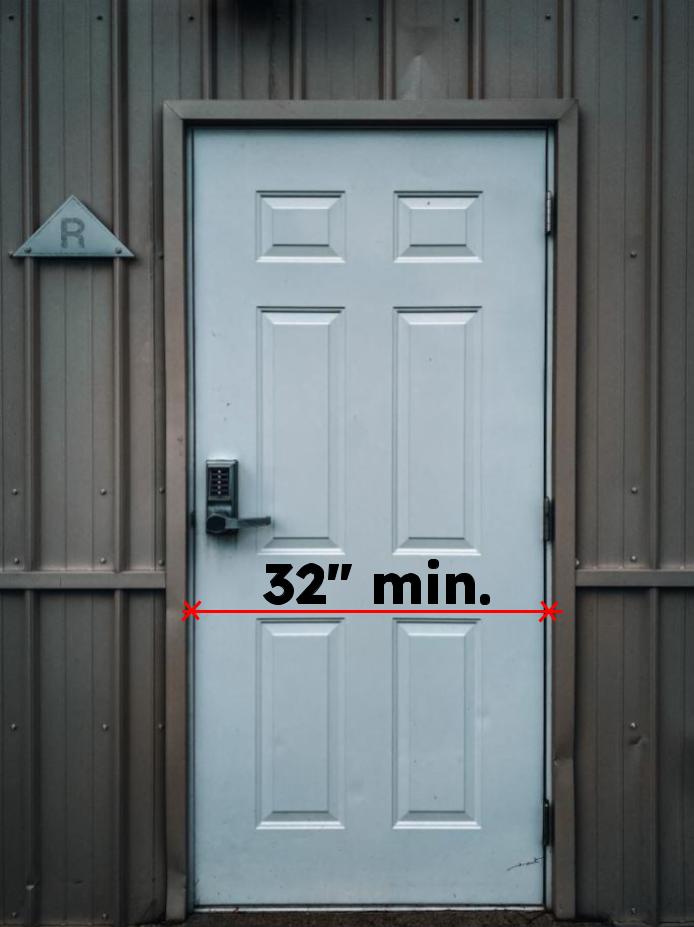
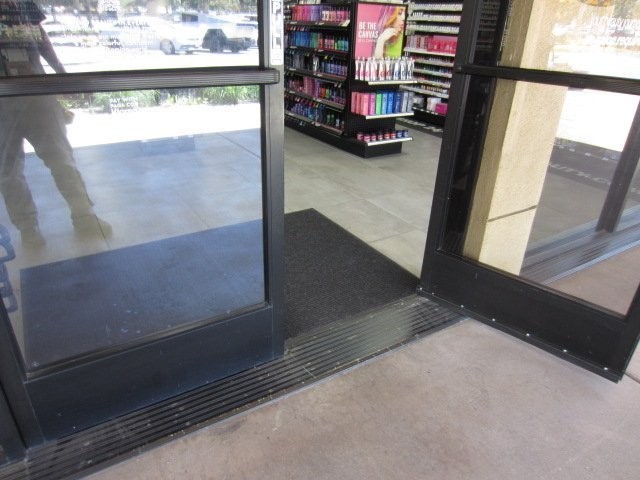
At least 60% of public entrances must be accessible [§206.4.1]. Each accessible door needs 32″ of clear width, enough level floor space on both sides, hardware 34″–48″ high that works without tight grasping or twisting, and a threshold no higher than ½” [§404.2]. See ADA door requirements.
Counters, restrooms and signs
Every type of sales or service counter needs an accessible portion, 36″ long minimum and 36″ high maximum [§227.3, §904.4]. Restrooms open to customers must meet the toilet, grab bar, lavatory and turning space rules in our ADA bathroom requirements guide. Permanent room signs, like restroom signs, need raised characters and Braille mounted 48″–60″ above the floor [§703.4.1].
Policies, not just buildings
Title III also covers how you run the business. You must allow service animals, and staff may ask only two questions: is the animal required because of a disability, and what work or task has it been trained to perform. You cannot ask for papers or proof of training [§36.302(c)(6)]. Your website is part of your services too; our ADA compliant website guide explains what that means.
ADA requirements for restaurants and bars
Restaurants draw more ADA complaints than almost any other business because every guest uses the same small set of features: the entrance, the host stand, the tables and the restroom.
- Every dining area, including raised, sunken and outdoor areas, must be on an accessible route. In alterations, an existing raised or sunken area can be skipped if the same services and decor are offered in an accessible area [§206.2.5].
- 5% of seating and standing spaces at dining surfaces must be accessible. Bars count as dining surfaces [§226.1, Advisory 902.1].
- Table and bar tops at accessible spaces must be 28″–34″ high, with knee clearance at least 27″ high and 30″ wide [§902.3, §306.3]. A 42″ bar with no lowered section is one of the most common violations we find.
- Self-serve items like condiments, drinks and utensils must be within reach range (15″–48″), and tray slides must be 28″–34″ high [§904.5].

For measurements and photos, see ADA table requirements, ADA bar counter requirements and our definition of ADA seating.
ADA requirements for retail stores
In a store, the inspector follows a shopper’s path: in the door, down the aisles, into the fitting room and through the check-out.
| Check-out aisles of each type | Accessible aisles required |
|---|---|
| 1 to 4 | 1 |
| 5 to 8 | 2 |
| 9 to 15 | 3 |
| 16 and over | 3, plus 20% of the additional aisles |
Stores with less than 5,000 sq ft of selling space need only one accessible check-out aisle [Table 227.2]. An accessible check-out counter is 38″ high max, and any edge protection can rise no more than 2″ above it [§904.3.2]. Other retail items:
- Aisles on the accessible route must stay at least 36″ wide, and merchandise displays cannot shrink them [§403.5.1].
- Self-service shelves must be on an accessible route, but the shelves themselves do not have to be within reach range [§225.2.2].
- Fitting rooms: at least 5%, and no fewer than one of each type in each cluster, must be accessible, with a turning space, a bench and hooks within reach [§222.1, §803].
ADA requirements for offices
An office that sees clients or customers, such as an insurance agency, law firm, bank or real estate office, is a place of public accommodation. An office building that never serves the public is a commercial facility and mainly has to comply when it is built or altered.
- Reception desk: a reception desk is a service counter, so it needs a 36″-long portion no higher than 36″ [§904.4]. A tall transaction ledge with no lowered section is the item we flag most in offices.
- Upper floors: private buildings under 3 stories, or under 3,000 sq ft per story, can skip the elevator, unless the building is a shopping center or the professional office of a health care provider [§206.2.3 Exc. 1].
- Employee work areas: areas used only by employees need an accessible way to approach, enter and exit, not full compliance inside [§203.9]. Shared paths through larger work areas must meet route rules, unless the area is under 1,000 sq ft and set off by permanent partitions [§206.2.8]. Changes for a specific employee are handled as reasonable accommodations under Title I.
ADA requirements for medical and dental offices
Doctors, dentists, chiropractors and therapists are named in the Title III list of service businesses [§36.104], and they face stricter rules than an ordinary office:
- No elevator exception. The professional office of a health care provider must have an accessible route to every floor, even in a small two-story building [§206.2.3].
- More accessible parking at some sites: 10% of patient and visitor spaces at hospital outpatient facilities, and 20% at rehabilitation and outpatient physical therapy facilities [§208.2.1, §208.2.2].
- Patient rooms in hospitals and similar facilities: at least 10% of patient sleeping rooms need mobility features, and 100% in facilities that treat conditions affecting mobility [§223.2].
- Exam rooms and equipment: patients who use wheelchairs must be able to get into the room, turn around and transfer to the table. The Access Board’s accessible exam table and scale standards are now mandatory for state and local government providers [28 CFR §35.210–§35.212]; for private practices they are the best guide to follow.
ADA requirements for hotels
Hotels are judged by room counts. A 100-room hotel needs 5 rooms with mobility features (1 with a roll-in shower) and 9 rooms with communication features such as visual alarms and notification devices [Table 224.2, Table 224.4]. Those rooms must be spread across the room types, bed counts and price levels that other guests can choose from [§224.5]. Lobbies, pools, fitness rooms, parking and the front desk follow the same rules as any other business. Our ADA hotel room requirements guide has the full count table and the bathroom details, and ADA pool requirements covers pool lifts.
ADA requirements for gyms and fitness centers
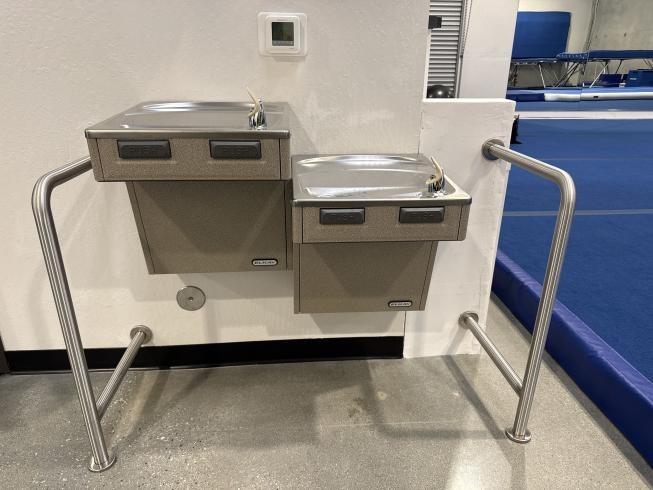
- Machines: at least one of each type of exercise machine must have a 30″ x 48″ clear floor space beside it for a transfer or for use from a wheelchair, on an accessible route [§236.1, §1004.1]. Two machines can share one clear space.
- Locker rooms: at least 5%, and no fewer than one of each type in each cluster, must be accessible [§222.1].
- Lockers: at least 5%, and no fewer than one of each type, must be within reach range with a clear floor space in front [§225.2.1, §811].
- Pools and spas need accessible means of entry, usually a pool lift [§242].
ADA requirements for apartments
Most private apartment units are covered by the Fair Housing Act, not the ADA. The Fair Housing Act design rules apply to buildings of 4 or more units built for first occupancy after March 13, 1991: every unit in an elevator building, and ground-floor units in other buildings [24 CFR §100.201, §100.205]. The ADA still applies to the parts of the property the public uses, such as the leasing office, its parking, its restroom and the route to it.
Churches and private clubs
Religious organizations and true private clubs are exempt from Title III [§36.102(e)]. Two catches: a private club that opens its facilities to the public (for example, renting its hall for public events) is covered for that use, and a non-religious business that pays rent to a church, like a preschool, is covered even though the church is not. Your state building code can still require access when you build or remodel.
California adds more for businesses
California businesses follow both the ADA and the California Building Code (CBC) Chapter 11B, and the stricter rule wins. A few differences we see on almost every site:
- All public entrances must be accessible, not 60% [11B-206.4.1].
- Larger parking spaces: 108″ wide for cars, 144″ for vans, 216″ long, plus the “Minimum Fine $250” and tow-away signs [11B-502].
- Lower door hardware (34″–44″) and wider routes (48″ walks, 44″ corridors) [11B-404.2.7, 11B-403.5.1].
- Bigger money risk: under the Unruh Act every ADA violation is also a state violation, with minimum damages of $4,000 per occasion plus attorney’s fees [Civ. Code §51(f), §52(a)].
The protection is a CASp inspection. A business inspected by a Certified Access Specialist before it is sued can ask for a 90-day stay and early evaluation conference [§55.54], and businesses with 50 or fewer employees get a 120-day window to fix the noted items with no minimum damages [§55.56(g)(3)]. Commercial leases must also say whether the space has been CASp-inspected [§1938].
Penalties and tax help
Most ADA cases are private lawsuits, which can force repairs and attorney’s fees. When the Department of Justice brings the case, civil penalties can reach $118,225 for a first violation and $236,451 for a later one [28 CFR §85.5]. If a demand letter has already arrived, read our step-by-step lawsuit guide.
Two federal tax rules soften the cost of fixes. Small businesses (up to $1 million in revenue or 30 full-time employees) can claim the Disabled Access Credit: 50% of eligible spending between $250 and $10,250, up to $5,000 a year (IRS §44). Any business can deduct up to $15,000 a year for removing barriers (IRS §190). Ask your tax advisor how they apply to you.