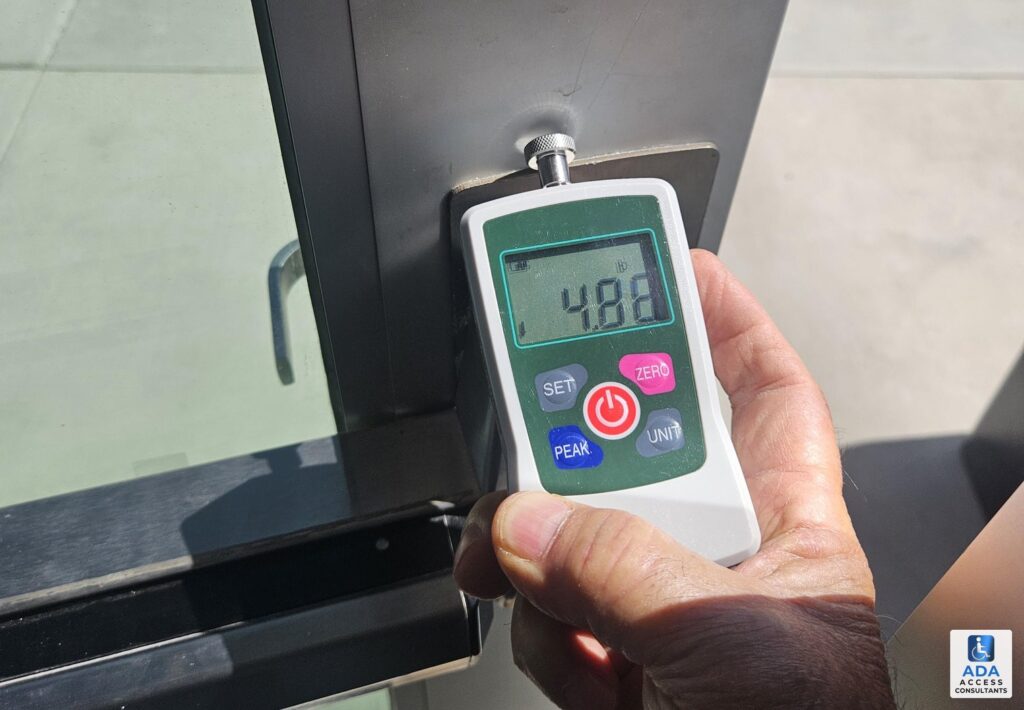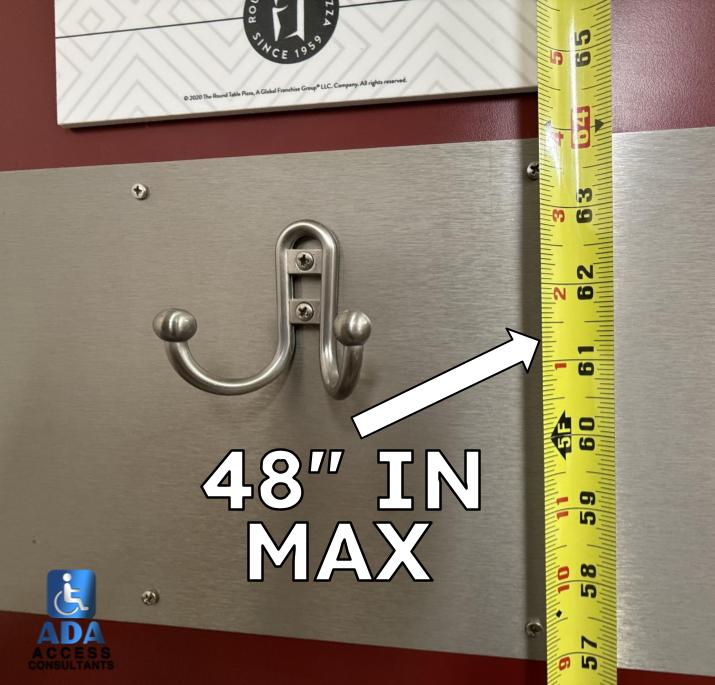
Under the ADA, light switches, outlets, thermostats, keypads, alarm pulls and fire extinguisher cabinet handles must be mounted so the part you touch is between 15″ and 48″ above the floor [§205.1, §308]. Wall-mounted objects between 27″ and 80″ high can’t stick out more than 4″ into a hallway [§307.2], and every control must work with one hand, without tight grasping or twisting, using 5 lb of force or less [§309.4]. California measures switches and outlets to the electrical box instead of the switch itself, which makes its rule a little stricter [CBC 11B-308.1.1, 11B-308.1.2].
These are some of the most common findings in our reports because they are easy to get wrong: an electrician sets the box at a “standard” height, a fire extinguisher vendor hangs the cabinet at eye level, or a keypad goes in wherever the wire comes out. Every photo below is from our own 2026 inspections of offices, apartments and storage facilities in California.
ADA mounting heights at a glance
| Element | 2010 ADA Standards | California (CBC 11B) | Fire code / other |
|---|---|---|---|
| Light switch | 48″ max to the switch [§308] | 48″ max to the top of the box [11B-308.1.1] | — |
| Electrical outlet | 15″ min to the outlet [§308] | 15″ min to the bottom of the box [11B-308.1.2] | — |
| Thermostat and HVAC controls | 15″–48″ [§205.1, §308] | 15″–48″, measured to the box [11B-308.1.1] | — |
| Keypad, card reader, intercom, doorbell | 15″–48″ [§308] | Same | — |
| Fire alarm pull station | 15″–48″ [§308] | Same | Handle 42″–48″ [IFC/CFC 907.4.2.2] |
| Fire extinguisher cabinet handle | 48″ max, no twisting [§308, §309.4] | Same | — |
| Fire extinguisher on a hook | Not set by the ADA (portable equipment) | Same | Top 60″ max (40 lb or less), 42″ max (over 40 lb), bottom 4″ min [NFPA 10; IFC/CFC 906.9] |
| Anything on a wall, 27″–80″ high | 4″ max projection [§307.2] | Same [11B-307.2] | — |
| Apartments (Fair Housing Act) | Switches, outlets and thermostats 15″–48″ in covered units [24 CFR §100.205; HUD Fair Housing Accessibility Guidelines] | ||
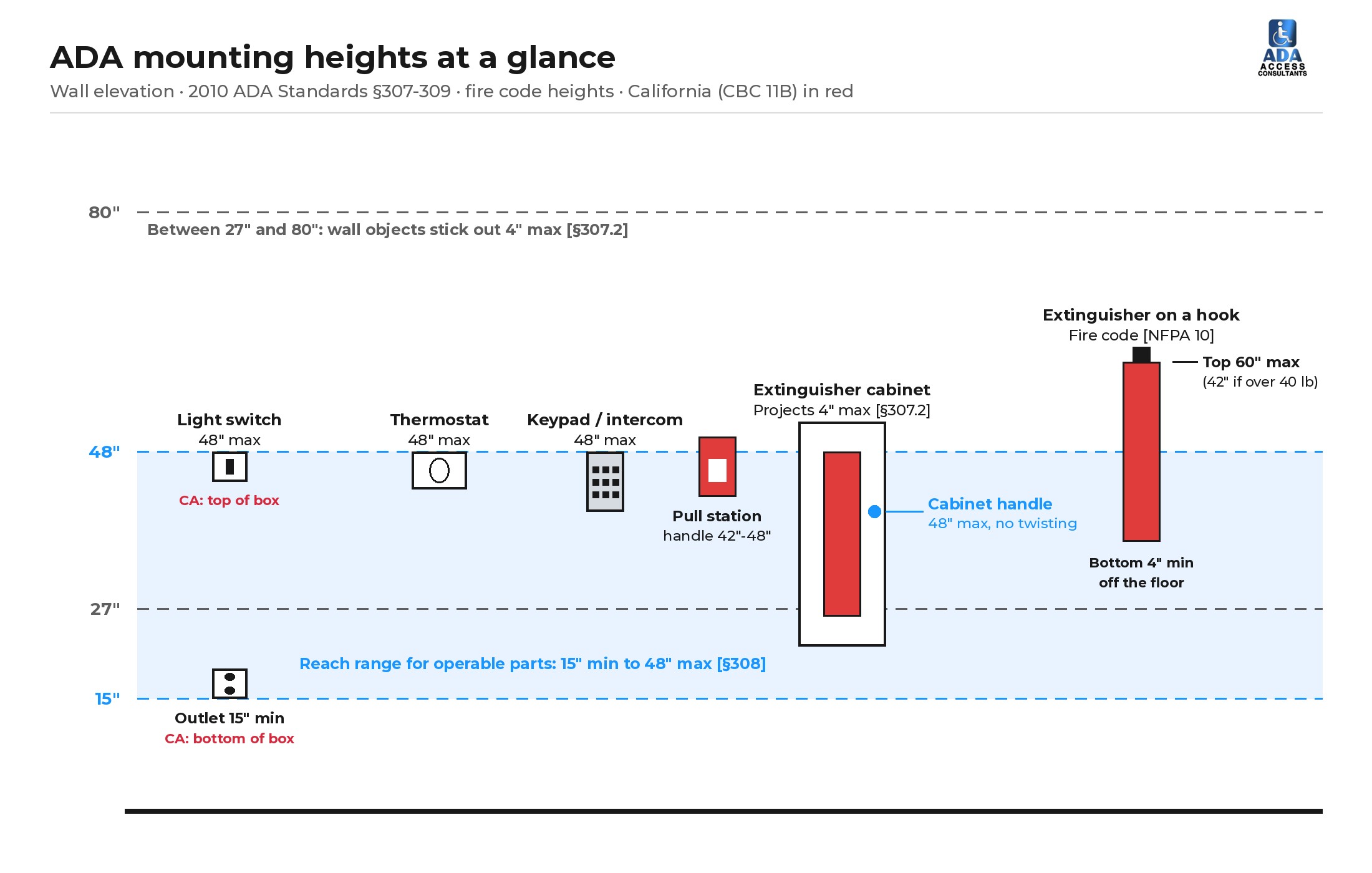
The rule behind every height: the 15″ to 48″ reach range
The ADA doesn’t have a separate height for each device. Instead, it says operable parts (anything a person touches to use something) must sit inside the reach range of a person using a wheelchair [§205.1, §309.3]. The Access Board lists what that covers: “light switches, circuit breakers, duplexes and other convenience receptacles, environmental and appliance controls, plumbing fixture controls, and security and intercom systems” [Advisory 205.1].
- Unobstructed reach, forward or side: 48″ max and 15″ min above the floor [§308.2.1, §308.3.1].
- Reaching forward over a counter: 48″ max if the counter is 20″ deep or less, 44″ max if it is 20″–25″ deep [§308.2.2].
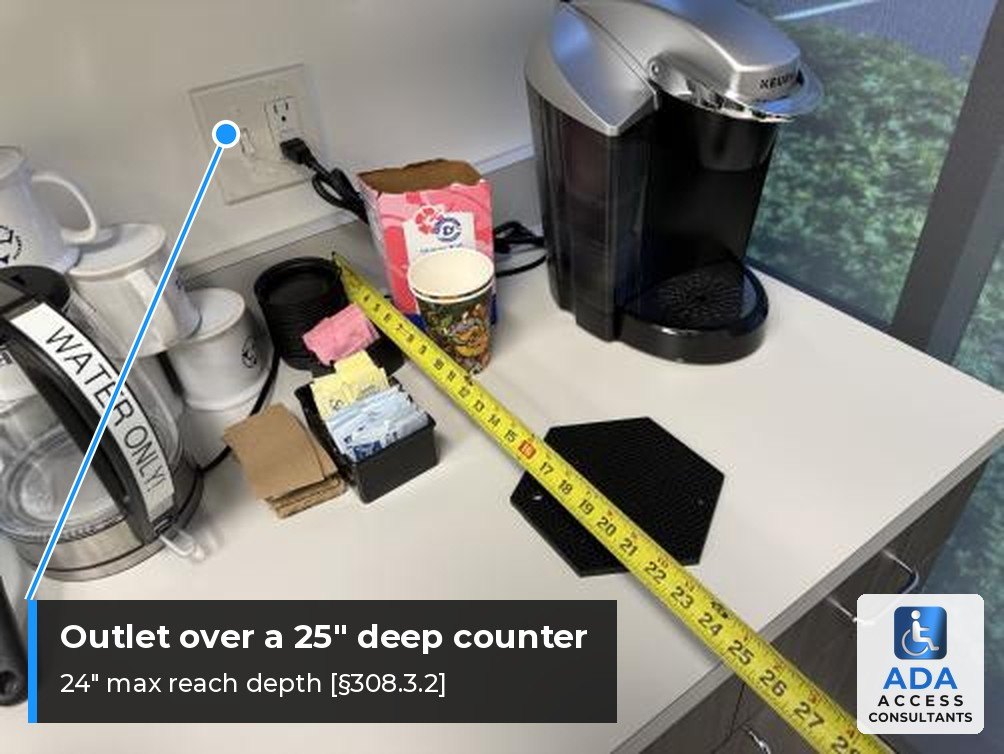
- Reaching sideways over a counter no higher than 34″: 48″ max over 10″ deep or less, 46″ max over 10″–24″ deep. Deeper than 24″ is out of reach [§308.3.2].
- Clear floor space: a 30″ x 48″ level space in front of or beside the control, so a wheelchair can pull up to it [§309.2, §305].
Only the part you operate has to be in the range. The Access Board’s guide says non-operable portions “can be located outside the range”, so a tall thermostat housing or a cabinet frame is fine as long as the button, dial or handle is at 48″ or lower. For the full set of reach diagrams, see our reach range requirements guide.
ADA light switch height
The ADA light switch height is 48″ maximum to the highest part of the switch you operate, and 15″ minimum [§308]. The rule applies to every light switch in a public area, accessible room or accessible route, and light switches can’t use the “redundant control” exception that lets other duplicate controls skip the rule [§205.1 Exc. 6].
California is stricter on where you measure: the high reach for switches and controls is measured to the top of the outlet box, not the toggle [CBC 11B-308.1.1]. A single-gang box is about 4″ tall, so a box with its top at 48″ puts the toggle near 46″. If you build in California, set the top of the box at 48″ or lower and you meet both codes.
Controls used only by service or maintenance staff, like a breaker panel or a switch in a mechanical room, are not covered [§205.1 Exc. 1]. A switch in a restroom, conference room, hotel room or break room used by customers or visitors is.
ADA outlet height
The ADA outlet height is 15″ minimum above the floor to the outlet, and no higher than 48″ [§308]. In California, the 15″ is measured to the bottom of the outlet box and the 48″ to the top of the box [CBC 11B-308.1.2]. The California rule covers electrical receptacles on circuits of 30 amps or less and communication receptacles.
Some outlets are exempt [§205.1]:
- Receptacles that serve a dedicated use, like the outlet behind a refrigerator, dishwasher or wall clock.
- Floor receptacles.
- Where two or more outlets serve one stretch of kitchen counter with no sink or appliance in between, one of them can be out of reach. California deletes this exception, so every counter outlet must comply [CBC 11B-205.1 Exc. 3, “Reserved”].
The outlet that trips people up is the one behind a counter. A 25″ deep counter puts any outlet on the back wall out of reach for a side approach, because a side reach only works over 24″ or less [§308.3.2].
ADA thermostat height
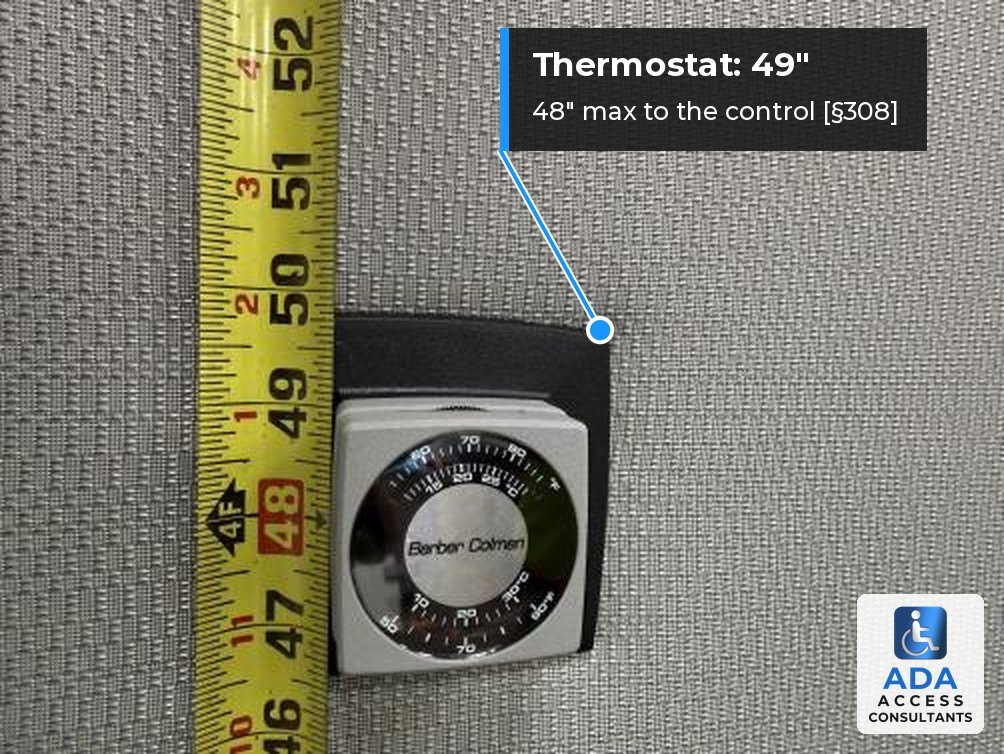
The ADA thermostat height is 48″ maximum to the highest control you use (buttons, dial or screen), and 15″ minimum [§205.1, §308]. Thermostats are “environmental controls” in Advisory 205.1, and California names heating, cooling and ventilating controls in its switch rule, measured to the box [CBC 11B-308.1.1].
Two practical points from the field:
- Older thermostats are often mounted around 5 feet, the old “eye level” habit. Replacing a thermostat is the easiest time to lower the box.
- A thermostat locked under a cover and used only by building staff is a maintenance control and doesn’t have to comply [§205.1 Exc. 1]. If guests or tenants set it, it does.
ADA fire extinguisher height
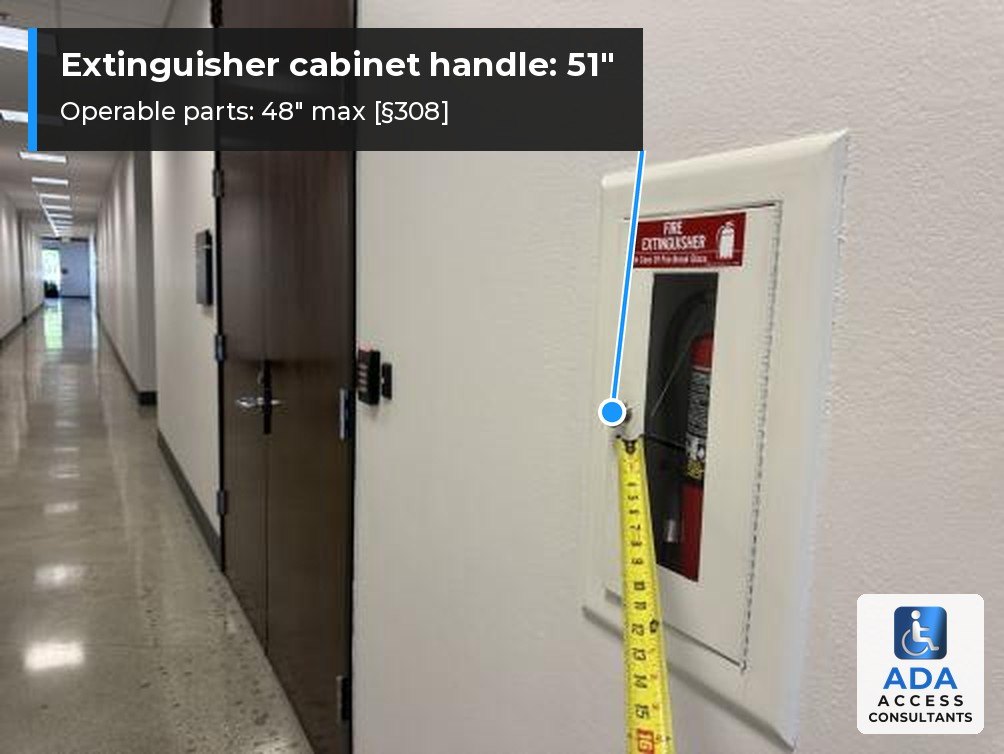
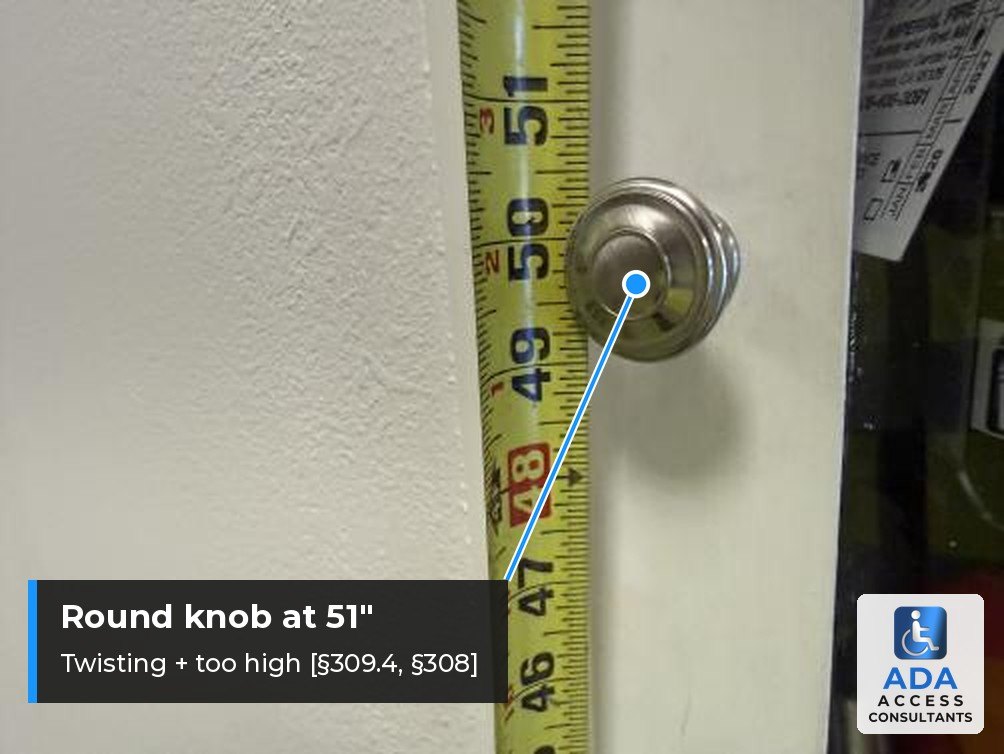
The ADA does not set a mounting height for a portable fire extinguisher, but the handle of a fire extinguisher cabinet is an operable part: it must be 48″ maximum and work without twisting, and the cabinet can’t stick out more than 4″ if its bottom edge is higher than 27″ [§307.2, §308, §309.4]. The Access Board’s guide says the rules cover “fixed elements, such as cabinet hardware” and not “non-fixed components, such as fire extinguishers.”
The height of the extinguisher itself comes from the fire code [NFPA 10; IFC and California Fire Code 906.9]:
- Extinguishers weighing 40 lb or less: top no higher than 5 feet (60″).
- Extinguishers over 40 lb: top no higher than 3½ feet (42″).
- Bottom at least 4″ above the floor.
In practice, many CASp inspectors, including ours, still note an extinguisher handle above 48″ as a barrier, because someone has to reach up and lift it off the hook. A typical 5 or 10 lb extinguisher hung with its handle at 48″ or lower meets the ADA reach range and the fire code at the same time, so that is the height we recommend.
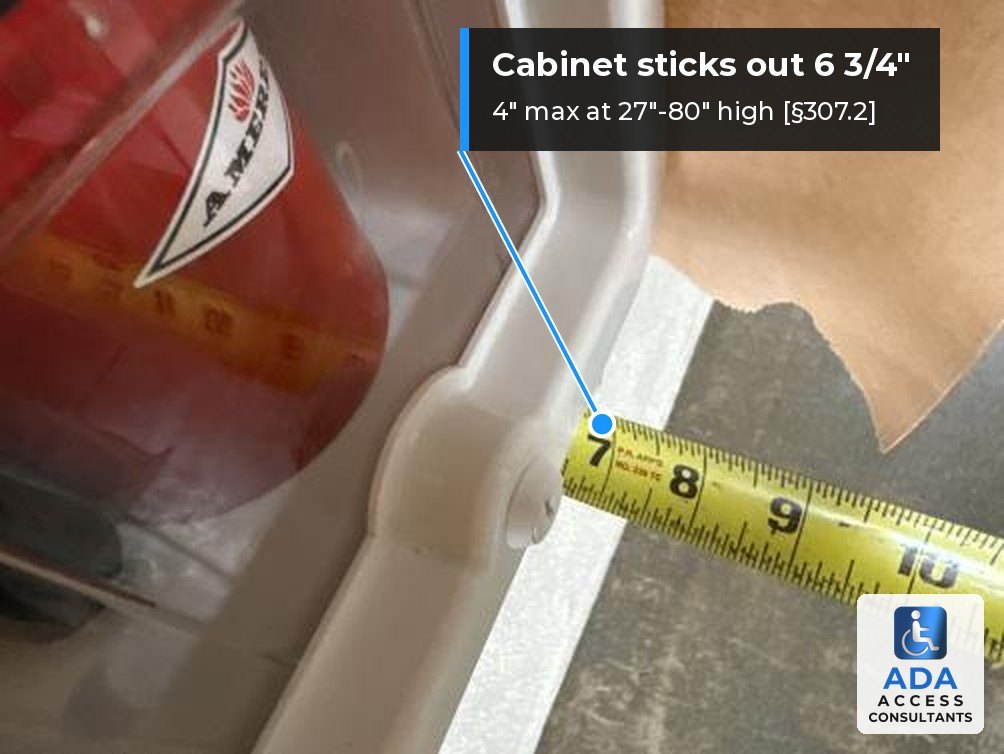
The other extinguisher problem is depth. A surface-mounted cabinet often projects 6″ or more off the wall, and its bottom edge sits well above 27″, where a person using a cane won’t detect it. Use a semi-recessed or fully recessed cabinet, or a wall bracket that keeps the extinguisher within 4″ of the wall. Read more in our ADA operable parts guide.
Fire alarm pull station height
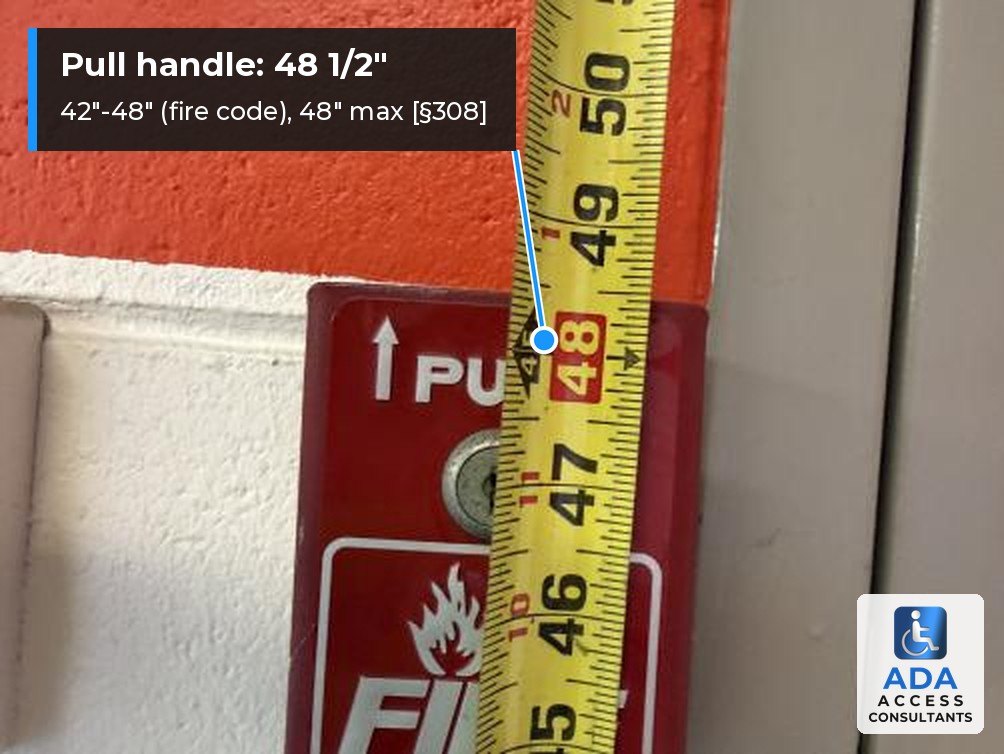
Manual fire alarm boxes (pull stations) must be mounted with the handle between 42″ and 48″ above the floor under the International Fire Code and the California Fire Code [907.4.2.2]. They are also operable parts under the ADA, so 48″ is the top for both [§205.1, §308]. The visible and audible alarms themselves follow NFPA 72 under the ADA [§702.1].
Keypads, card readers, intercoms and doorbells
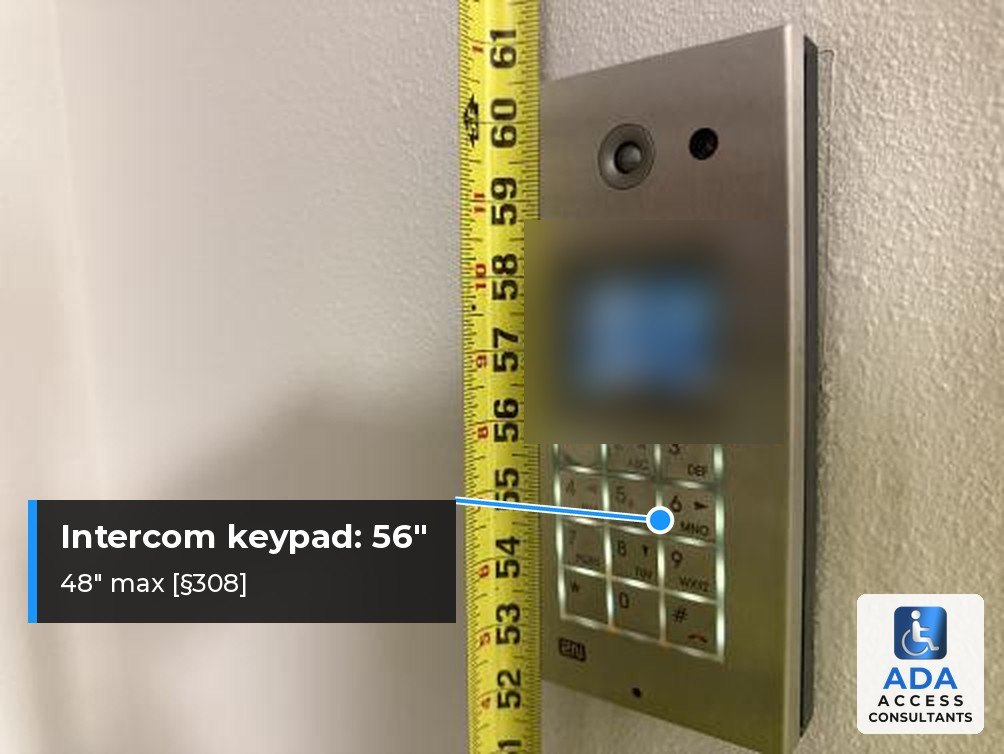
Access control keypads, card readers, call boxes, intercoms and doorbells are operable parts, so the highest key or button must be 48″ maximum and the lowest 15″ minimum, with clear floor space in front [§308, §309]. The key card or fob itself doesn’t have to comply, only the fixed reader. At gates and parking entries, the keypad also needs a level 30″ x 48″ space beside or in front of it, and its housing can’t project more than 4″ into a walkway [§307.2].
How controls must work, not just where they go
Height is only half of the rule. Every operable part must be usable with one hand, without tight grasping, pinching or twisting of the wrist, and with 5 lb of force or less [§309.4]. Rocker and toggle switches, lever handles, push buttons and touch pads pass. Round knobs, small dials you have to pinch, and stiff key switches fail. Paper towel and soap dispensers follow the same rule; see our paper towel dispenser requirements.
Apartments: Fair Housing Act heights
Inside covered apartments (buildings of 4 or more units first occupied after March 13, 1991), the Fair Housing Act requires “light switches, electrical outlets, thermostats, and other environmental controls in accessible locations” [24 CFR §100.205(c)(3)(ii)]. HUD’s guidelines use the same 15″–48″ range, measured to the operable part, with lower maximums over deep counters. A private single-family home isn’t covered by the ADA or the Fair Housing Act unless part of it is used as a business open to the public.
Common mounting height violations we find
- Fire extinguisher cabinet handles above 48″, often with a round knob.
- Surface-mounted extinguisher cabinets and keypads sticking out more than 4″ into a corridor.
- Thermostats and light switches just over 48″, repeated in every room.
- Outlets and switches behind counters deeper than 24″.
- Intercoms, keypads and doorbells at gates and entries mounted in the mid-50s.
- Controls with no 30″ x 48″ clear floor space because a trash can, chair or planter sits in front.
Most of these are inexpensive to fix, which also makes them easy targets in a demand letter. An ADA inspection lists every one with a measurement and a photo, so your electrician can fix them in a single visit.
California differences
- Measuring point. Switches, controls and outlets are measured to the top and bottom of the electrical box, not to the switch or plug [CBC 11B-308.1.1, 11B-308.1.2].
- Kitchen counter outlets. The ADA exception that lets one counter outlet be out of reach is deleted in California [11B-205.1 Exc. 3].
- Dwelling unit kitchens. In units with mobility features, where outlets serve a corner work surface, one must be 36″ from either wall at the inside corner [11B-205.1 Exc. 9].
- Everything else (15″–48″ reach, 4″ protrusion, 5 lb force) matches the ADA.
A CASp inspection checks both the ADA and CBC 11B, and in California the report gives you qualified defendant protections if a claim is filed [Civ. Code §55.52, §55.54].