
Under the 2010 ADA Standards, a swimming pool at a hotel, gym, swim club, or other public facility needs at least two accessible means of entry, and at least one of them must be a pool lift or a sloped entry. A pool with less than 300 linear feet of pool wall needs only one, as long as it is a pool lift or a sloped entry [§242.2]. A spa needs one: a pool lift, a transfer wall, or a transfer system [§242.4]. This guide covers every number our licensed CASp inspectors measure at pools, how the rules apply to pools built before 2012, and where California asks for more.
If you own or manage a hotel, apartment community with a public leasing pool, fitness club, HOA that rents its pool to outside groups, or a city aquatic center, this is the page to keep. It is written in the order we check a pool during a CASp inspection, from the gate to the water.
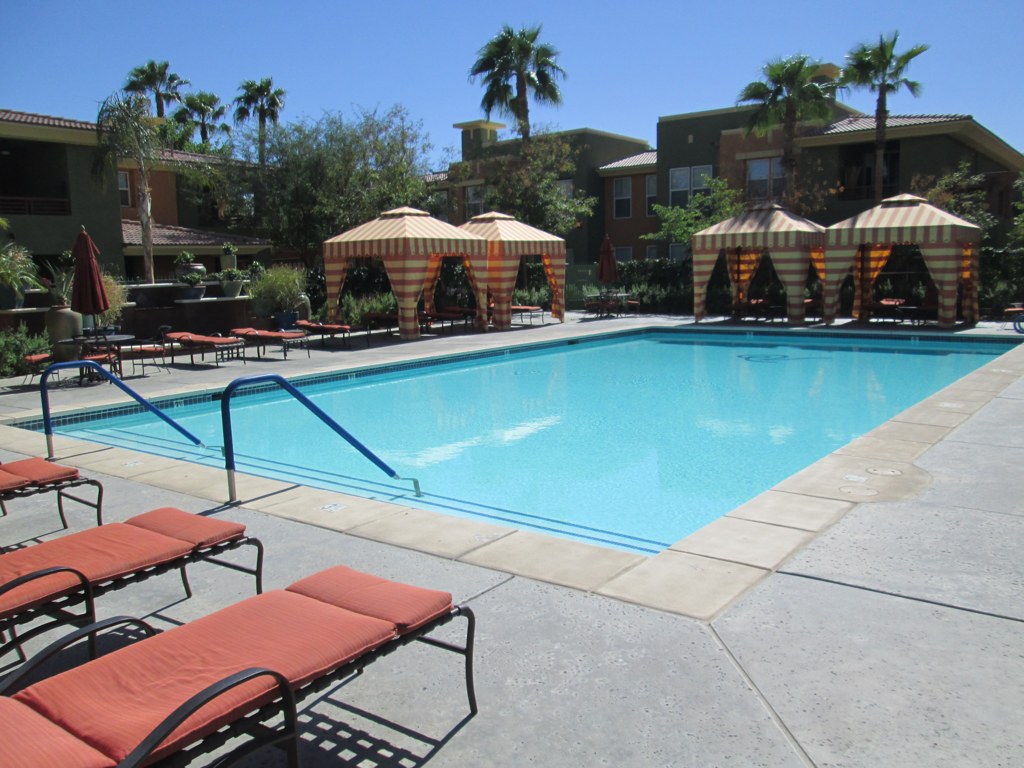
ADA pool requirements at a glance
| Pool type | Accessible means of entry required | Which kinds count |
|---|---|---|
| Swimming pool, 300 linear feet of wall or more | 2 | At least 1 pool lift or sloped entry; the 2nd can be a lift, sloped entry, transfer wall, transfer system, or pool stairs [§242.2] |
| Swimming pool, under 300 linear feet of wall | 1 | Pool lift or sloped entry only [§242.2 Exc. 1] |
| Wave pool, lazy river, sand-bottom pool, single-entry pools | 1 | Pool lift, sloped entry, or transfer system [§242.2 Exc. 2] |
| Wading pool | 1 | Sloped entry [§242.3] |
| Spa / hot tub | 1 | Pool lift, transfer wall, or transfer system; in a cluster of spas, 5% (at least 1) [§242.4] |
| Catch pool (bottom of a waterslide) | 0 | The pool edge must be on an accessible route [§242.2 Exc. 3] |
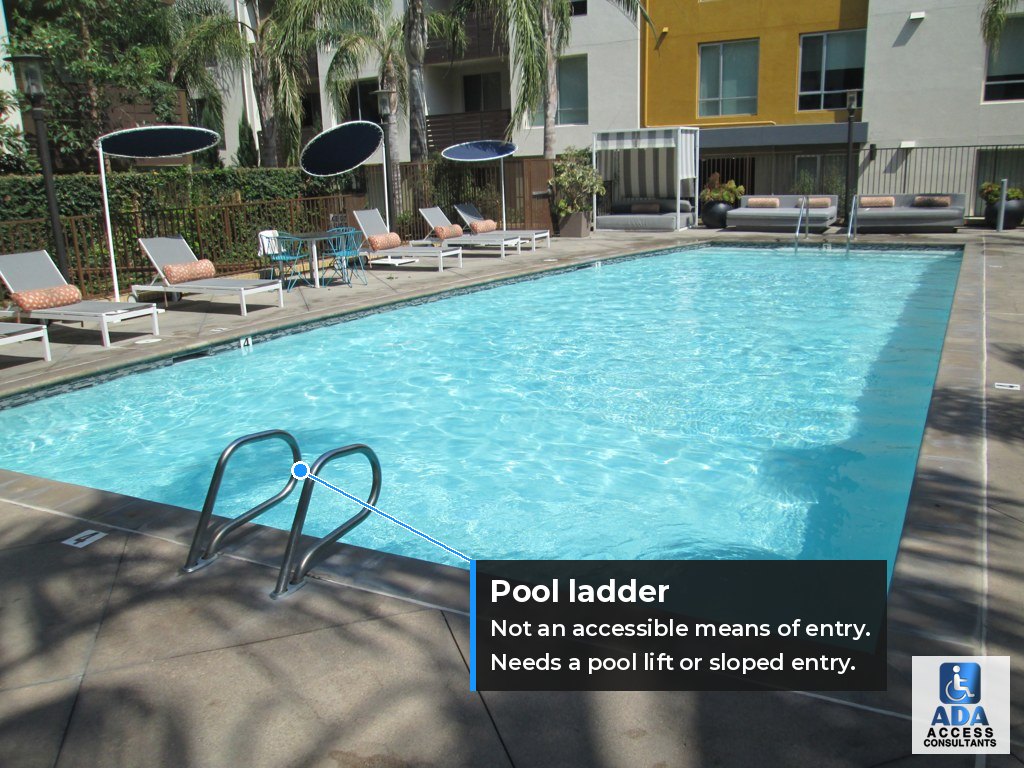
A ladder never counts. Neither do ordinary pool steps with a single handrail unless they meet §1009.6, and even then they can only be the second means of entry on a large pool.
Which pools have to meet ADA pool requirements?
The ADA covers pools in three ways, and the rule that applies depends on who owns the pool and who is allowed to swim in it.
Public accommodations (Title III)
Hotels, motels, resorts, health clubs, swim schools, recreation centers, public country clubs, and any business that lets the public use its pool are places of public accommodation. New and altered pools must fully meet §242 and §1009. Existing pools must be brought up to those Standards where it is readily achievable to do so (more on that below).
State and local government pools (Title II)
City pools, school district natatoriums, and park district aquatic centers fall under “program accessibility” [28 CFR 35.150]. A city with several pools does not have to make every one accessible, but the swimming program as a whole must be. A city with only one pool must make that pool accessible.
Apartment, condo, and HOA pools
A community pool limited to residents and their guests is not covered by the ADA accessibility requirements. That changes the moment the pool is made available to the public for rental or use, for example swim lessons open to non-residents or a pool rented out for events: then Title III applies. Apartment pools are still covered by the Fair Housing Act, which is a separate law with its own design rules. When in doubt, have the property reviewed; the line between “private” and “open to the public” is where we see owners get surprised.
How many pool lifts or accessible entries do you need?
Start by measuring the pool wall. The 300-foot test counts the entire perimeter, including walls at the diving end and walls where landscaping or a structure blocks entry (Advisory 242.2 Exc. 1). Owners often undercount by skipping the deep end.
- Under 300 linear feet: one pool lift or one sloped entry.
- 300 linear feet or more: two means of entry, at least one a pool lift or sloped entry. The Access Board recommends the two be different types and in different locations, so a person can choose the one that fits their disability.
- Spas: each spa needs one, unless spas are grouped in a cluster, where 5% (minimum 1) of the spas in each cluster must comply.
ADA pool lift requirements
The pool lift is the means of entry most owners choose, because it can be added to an existing pool without rebuilding the shell. Every one of these items is in §1009.2, and every one is something we put a tape on during an inspection.
| Item | 2010 ADA Standards | California (CBC 11B) |
|---|---|---|
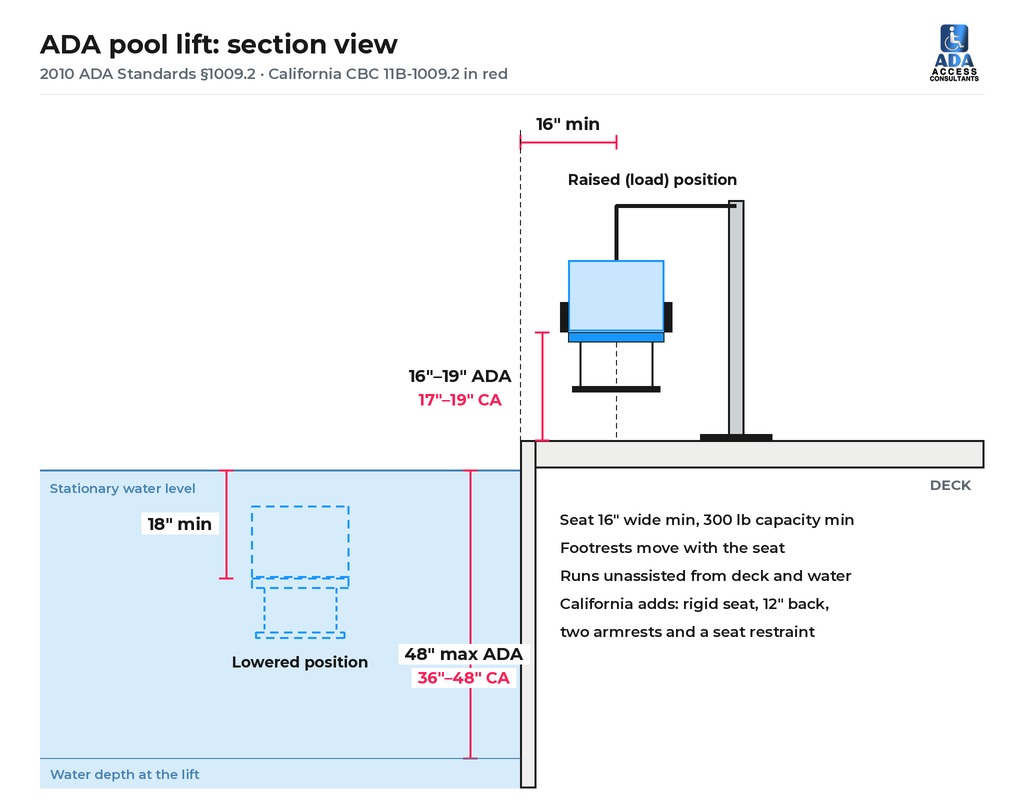
| Lift location (water depth) | Where the water is 48″ deep max [§1009.2.1] | Water 36″ min to 48″ max [11B-1009.2.1] |
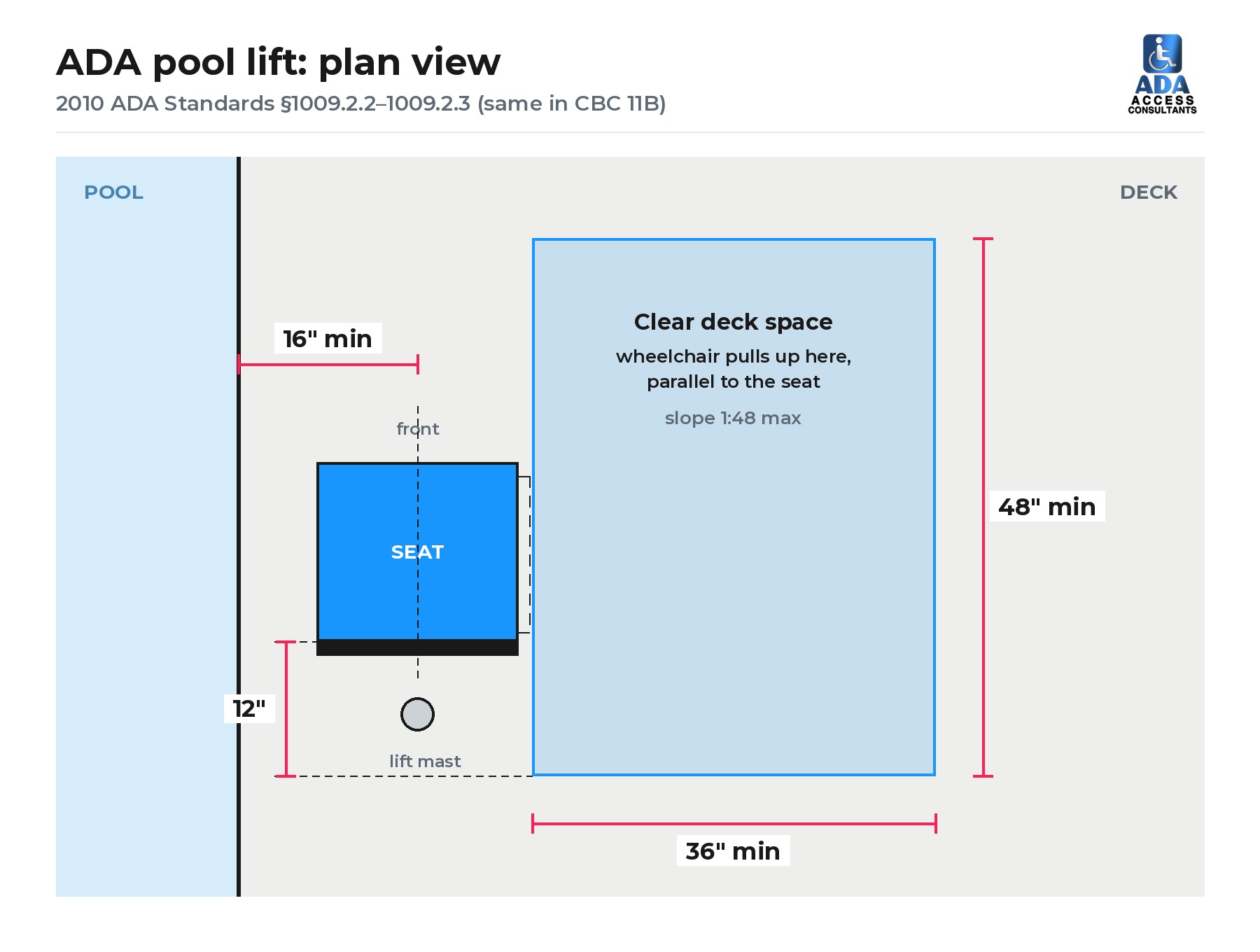
| Seat location | Seat centerline over the deck, 16″ min from the pool edge; deck between them 1:48 max slope [§1009.2.2] | Same |
| Clear deck space | 36″ wide × 48″ long min, beside the seat, starting 12″ behind the rear edge of the seat; 1:48 max slope [§1009.2.3] | Same |
| Seat height (raised) | 16″ min to 19″ max above the deck [§1009.2.4] | 17″ min to 19″ max; rigid seat with a back 12″ tall min and an occupant restraint [11B-1009.2.4] |
| Seat width | 16″ min [§1009.2.5] | Same |
| Footrests and armrests | Footrests that move with the seat (not required in spas); the armrest on the deck side must fold or remove [§1009.2.6] | Two armrests required; deck-side armrest folds or removes [11B-1009.2.6] |
| Operation | Unassisted operation from the deck and the water; controls per §309.4 [§1009.2.7] | Same, plus the lift must be stable with no unintended movement during transfer [11B-1009.2.7] |
| Submerged depth | Seat lowers to 18″ min below the stationary water level [§1009.2.8] | Same |
| Lifting capacity | 300 lb min; static load 1.5× rated load [§1009.2.9] | Same |
“Unassisted operation” is where most lifts fail
The rule exists so a swimmer is never stranded in the water waiting for staff. The person must be able to call the lift back from the water and run it from the seat. We routinely find lifts with the remote locked in an office, a dead battery, or a key switch the guest is never given. The equipment is compliant; the way it is being run is not.
Sloped entry requirements
A sloped entry is a ramp into the water. It follows the ramp rules in Chapter 4 (1:12 max running slope, landings, handrails) with pool-specific changes [§1009.3]:
- It must reach 24″ min to 30″ max below the stationary water level, and where a landing is required, at least one landing must sit in that same 24″–30″ band [§1009.3.2].
- Two handrails are required, with 33″ min to 38″ max clear between them [§1009.3.3]. The bottom handrail extension can be omitted.
- The surface does not have to be slip resistant [§1009.3.1 Exc.].
- In wading pools, the slope runs to the deepest point and handrails are not required.
A personal power wheelchair should not go into the water. That is why the Access Board recommends providing an aquatic wheelchair made of non-corrosive materials wherever a sloped entry is the accessible route into the pool. See our ADA handrail requirements for the gripping-surface rules that also apply here.
Transfer walls and transfer systems
These let a swimmer slide from a wheelchair onto a wall or platform and then lower into the water. They work well as the second means of entry on a large pool, and as the entry for a spa.
Transfer wall [§1009.4]
- Height 16″ min to 19″ max above the deck; depth 12″ min to 16″ max; length 60″ min.
- Clear deck space 60″ × 60″ min at the base, 1:48 max slope, centered on the grab bar (or on the space between two grab bars).
- At least one grab bar, perpendicular to the pool wall and running the full depth of the wall, with the top of the gripping surface 4″–6″ above the wall. Keep 24″ min clear on both sides of a single bar.
- Rounded, non-sharp edges.
Transfer system [§1009.5]
- A transfer platform at the top, 19″ min deep × 24″ min wide, at the same 16″–19″ height as a transfer wall.
- A 60″ × 60″ transfer space at the base of the platform, centered along a 24″ min side, 1:48 max slope.
- Transfer steps 8″ max high, each tread 14″–17″ deep and 24″ min wide; the bottom tread reaches 18″ min below the water level.
- Grab bars on each step and the platform (or one continuous bar), top of gripping surface 4″–6″ above the step nosing, on at least one side. For grab bar diameter and spacing, see our ADA grab bar requirements.
ADA pool stairs
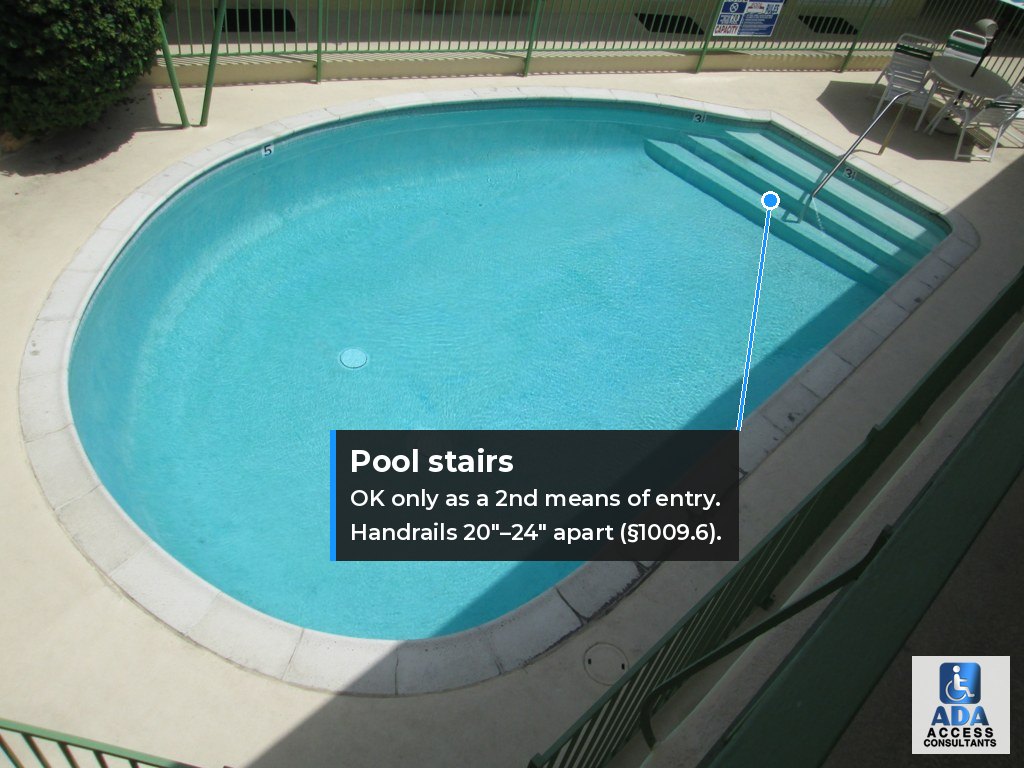
Accessible pool stairs follow the regular stair rules in §504, except risers do not have to be 4″–7″ high as long as they are uniform. Handrails must be 20″ min to 24″ max apart, and the bottom extension is not required [§1009.6].
ADA spa and hot tub requirements
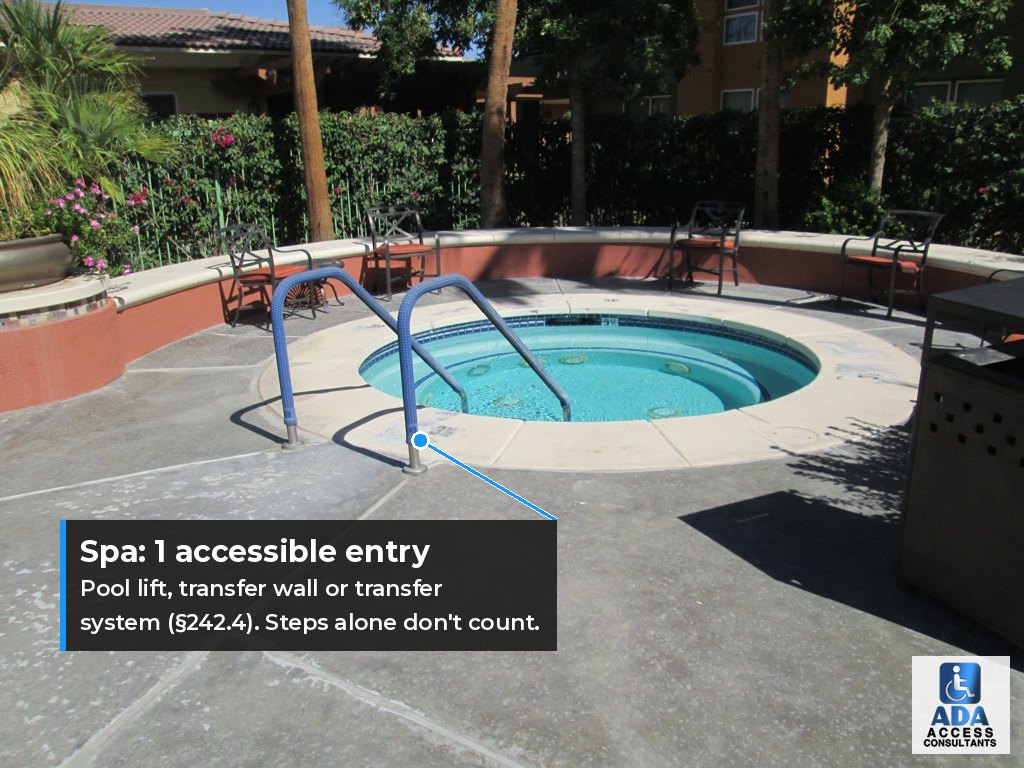
Spas are where we find the most misses, because owners assume handrail steps are enough. They are not. A spa needs a pool lift, a transfer wall, or a transfer system [§242.4]. Pool stairs and sloped entries are not on the list. Lifts used in spas do not need footrests, but every other §1009.2 rule still applies.
What about pools built before 2012?
The pool rules were new in the 2010 Standards. New and altered pools have had to comply since March 15, 2012. For existing pools, the Department of Justice extended the compliance date for accessible entry and exit to January 31, 2013. Since then, these rules apply:
- Readily achievable barrier removal (Title III). If you can install a compliant fixed pool lift without much difficulty or expense, you must. If you cannot, a non-fixed lift that otherwise meets the Standards is the fallback. If even that is not readily achievable, you should plan to do it when it becomes so. The obligation is ongoing and is judged on your resources, including a parent company’s [28 CFR 36.304].
- Fixed vs. portable. The DOJ’s test is whether the lift is attached to the deck or apron in some way, not whether it can be moved. A portable lift that is anchored to the deck counts as fixed. Lifts bought before March 15, 2012 can stay non-fixed if they are kept in position and working whenever the pool is open; lifts bought after that date generally must be fixed where readily achievable.
- Out and working during all open hours. A lift can be stored when the pool is closed, but it must be poolside and operational every hour the pool is open. Storing it in a closet “available on request” does not comply.
- No sharing. One lift moved between two pools is not allowed unless providing one at each would be an undue burden.
- Alterations. Any physical change that affects or could affect how usable the pool is counts as an alteration and must meet the 2010 Standards to the maximum extent feasible. Work on filtration and chlorination systems does not.
Small businesses can offset the cost. The IRS Section 44 Disabled Access Credit covers 50% of eligible access spending between $250 and $10,250 a year (up to $5,000) for businesses with $1 million or less in revenue or 30 or fewer full-time employees, and the Section 190 deduction allows up to $15,000 a year for barrier removal. Ask your tax advisor how they apply to you.
California differences (CBC 11B)
California adopted the same scoping in 11B-242, but tightened the pool lift itself. If your pool is in California, design to the stricter number:
- Lift located where the water is 36″ min to 48″ max deep, not just 48″ max.
- Seat height 17″–19″ (not 16″–19″), with a rigid seat, a 12″ min back, two armrests, and an occupant restraint.
- The lift must be stable with no unintended movement while a person transfers.
California also adds money to every violation. Each ADA violation is an Unruh Act violation with a $4,000 minimum per occasion [Civ. Code §51(f), §52(a)]. A Certified Access Specialist (CASp) report before a claim is filed can make you a qualified defendant, with a 90-day stay and reduced damages if you fix the items on schedule [Civ. Code §§55.54, 55.56].
The pool violations we find most often
- No accessible entry at all. Ladders and steps only, or a spa with grab rails and nothing else.
- Lift not in place. Covered, stored, chained, or with a dead battery during open hours.
- Lift at the wrong depth. Set at the deep end, where water exceeds 48″.
- Sloped or obstructed deck. The 36″ × 48″ clear deck beside the seat is cluttered with lounge chairs or slopes more than 1:48 toward the drain.
- No route to the water. The gate, deck, and lift are not on an accessible route from the building [§206.2.2], or the gate latch needs tight grasping or too much force (see ADA operable parts).
- Staff who do not know how the lift works. The DOJ expects training; a lift nobody can run is a lift that is not available.
Pools are only one part of a property. A hotel pool inspection usually sits inside a full-site review with parking, the lobby, and the accessible guest rooms. Our ADA compliance checklist covers the rest of the site in the same order a plaintiff’s investigator walks it.

