Guide to ADA Sign Requirements (2026): Complete Checklist
ADA sign requirements are essential in completing accessible routes and ADA compliant properties. This guide will dive into what the Americans with Disabilities Act (ADA) requires regarding where signs need to be, the sign dimensions, text and symbol requirements, and more. The 2010 ADA standard for accessible design is still enforceable in 2026 and needs to be considered in new construction or when improvements are being made on a property.
What Are ADA Sign Requirements? (And Which Signs Actually Have to Comply)
ADA sign requirements are the backbone in distinguishing an accessible route and need to be present in places like door ways, accessible routes, around accessible elements, and many more places. When you have correct signage and positioning, you are providing an accessible route to people with disabilities. Specific signs and scenarios determine if you sign needs to be compliant. Reach out for an ADA consultation and find out how you can improve the signs at your property.
Sign Types That Require Raised Characters and Braille
There are four types of ADA signs that require raised brailled characters. Permanent room or area ID signs (§216.2), exit doors and stairways (§216.4.1), elevator car controls, and rail station ID’s (§810.6.1). All of these standards are in place to ensure someone can navigate a route if they are vision impaired. Additionally the signage is helpful to people without disabilities because it often helps with navigation.
Signs Exempt from ADA Requirements
Within the Americans with Disabilities Act (ADA) there are exceptions to signs requiring compliance. Temporary signs that are posted for 7 days or less, addresses on buildings and properties, directories, logos, service menus, and assembly area seating numbers are not required to comply with ADA sign requirements.
Directional and Informational Signs: Visual Requirements
When installing directional and informational signs, your text must contrast with the background. Additionally, the text and braille must follow proper character sizing and need not be raised (§216.3).
Prevent ADA Signage Lawsuits
In the US, we’ve witnessed an influx of lawsuits related to ADA sign requirements. Businesses, developers, and property managers are facing litigation and paying costly lawyer feed and fines. If you want to mitigate your risks and lead by example in the customer service sector, ADA compliance should be apart of your mission.
ADA Sign Requirements: Mounting and Placement
ADA sign requirements include ADA sign height, ADA signage mounting height, ADA sign installation guidelines, and more. If you can implement all of the requirements correctly you have the best chance at avoiding an ADA related sign lawsuit. Also, you can sleep better at night knowing you’re providing proper access at your property.
The 48"– 60" Rule Explained
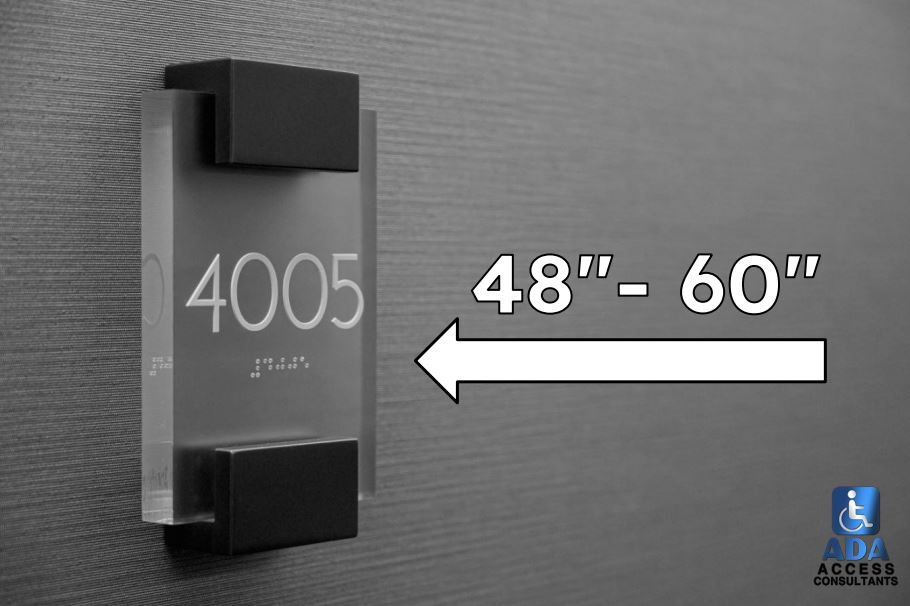
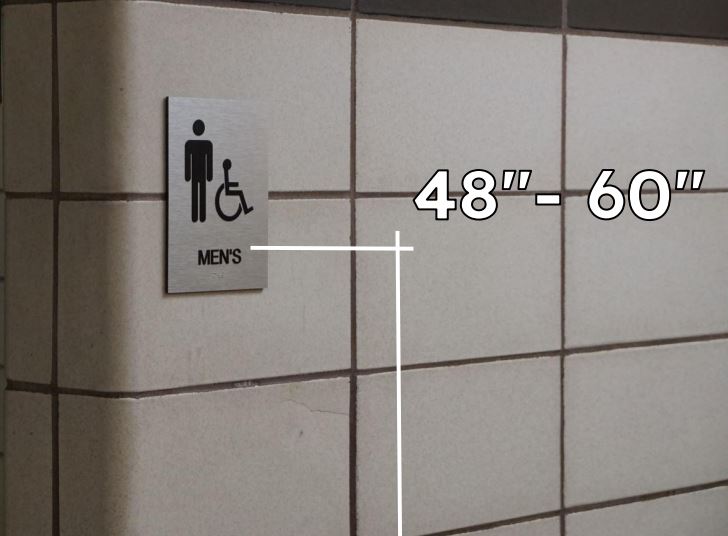
The 48” inch to 60” inch rule are ADA sign installation guidelines for the height of characters on signs. Measured from the baseline of the lowest character, you’re able to mount as low as 48” inches. Measuring to the baseline of the top characters, you can mount as high as 60” inches. Following these height requirements is a simple way to provide accessibility.
Clear Floor Space Requirements for Signs
When approaching signs, clear floor space is needed to properly read the raised characters on signs. An 18” inch x 18” inch floor space centered on the characters outside of the door swing is required. Check out our in-depth guide on clear floor space for more information.
Visual Character Mounting & Viewing Distance
When determining the height of characters, you can use the viewing distance formula to determine the size of your letters. The height and distance of your sign determines the character heights. Character size must be ⅝” minimum when the sign is under 6’ feet. Character size must increase ⅛” inch per additional foot of ADA signage mounting height.
Visual Character Mounting
When determining the height of characters, you can use the viewing distance formula to determine the size of your letters. The height and distance of your sign determines the character heights. Character size must be ⅝” minimum when the sign is under 6’ feet. Character size must increase ⅛” inch per additional foot of ADA signage mounting height.
Post Mounted and Overhead Signs
If your property has mounted overhead signs within the range of 27” inches to 80” inches, ensure you have no protrusions more than 12” inches into an accessible route. This ensures people with visual or physical disabilities can easily navigate a circulation path and not walk or roll into any protrusion. In addition, when installing signs make sure you have at least 80” inches of headroom clearance to make sure no one can hit their heads or arms on signs.
ADA Braille Requirements
ADA braille is an important part of accessible signs. Make sure you provide the correct braille standards to avoid any ADA complaints or lawsuits.
ADA Braille Dimensions
2010 ADA Standards for Accessible Design — Table 703.3.1 (§703.3)
Plan view drawn to scale at midpoint values. Cross-section enlarged for clarity.
| Measurement | Minimum | Maximum |
|---|---|---|
| 1Dot base diameter | 0.059 in1.5 mm | 0.063 in1.6 mm |
| 2Distance between two dots in the same cell 1 | 0.090 in2.3 mm | 0.100 in2.5 mm |
| 3Distance between corresponding dots in adjacent cells 1 | 0.241 in6.1 mm | 0.300 in7.6 mm |
| 4Dot height | 0.025 in0.6 mm | 0.037 in0.9 mm |
| 5Distance between corresponding dots from one cell directly below 1 | 0.395 in10 mm | 0.400 in10.2 mm |
Source: 2010 ADA Standards for Accessible Design, §703.3 & Table 703.3.1, U.S. Access Board.
Braille Dot and Cell Dimensions
ADA braille signs must have base diameter dimensions of .059” inches to .063” inches. The dot height requirement is .025″ inches minimum to 0.037″ inches maximum. ADA braille cell spacing requirements are .241” inches minimum to .300” inches maximum.
Braille Placement: 3/8" Below the Text
ADA compliant braille placement is important for denoting the differences between raised characters and braille. To ensure the best use, braille must be placed below the entire text block and be separated by at least ⅜” inches of space.
ADA Braille Sign Height
ADA Braille signs are required to follow the 48” inches minimum to 60” inches maximum standard for tactile ranges. This ensures the braille is not mounted too high or low to read.
Raised Character Requirements
Just like braille, signs have raised characters that people can use to read signs. Make sure you buy signs with the proper raised character requirements, or consult with and ADA expert for guidance!
Size, Depth, and Case
ADA sign regulations require 5/8″ inch minimum to 2″ inches tall maximum characters, raised 1/32” inches minimum, in uppercase only. All of these codes make reading raised characters as easy as possible.
Font and Stroke Rules
ADA signage standards include the font and stroke of the raised characters. Text must be sans serif only with no decorative faces or italic script. Stroke must be no more than 15% of the character height.
Character and Line Spacing
ADA signage guidelines include character and line spacing requirements. Codes require ⅛” inch minimum between characters and the line spacing must be 135% minimum to 170% maximum.
Finish, Contrast, and Pictogram Requirements
ADA sign requirements will go over the symbols on signs, also known as pictograms. Signs also have standards for the contrast of letters and what is on the sign. It may sound complicated, but hiring an ADA inspection team can help ease your worry and give you peace of mind you’re following the code correctly.
Non-Glare Finish and Dark-on-Light Contrast
ADA compliance in sign requires a non-glare finish and a light and dark contrast. This contrast makes reading the sign and distinguishing the raised characters and pictograms easier.
Pictogram Field: 6" Minimum
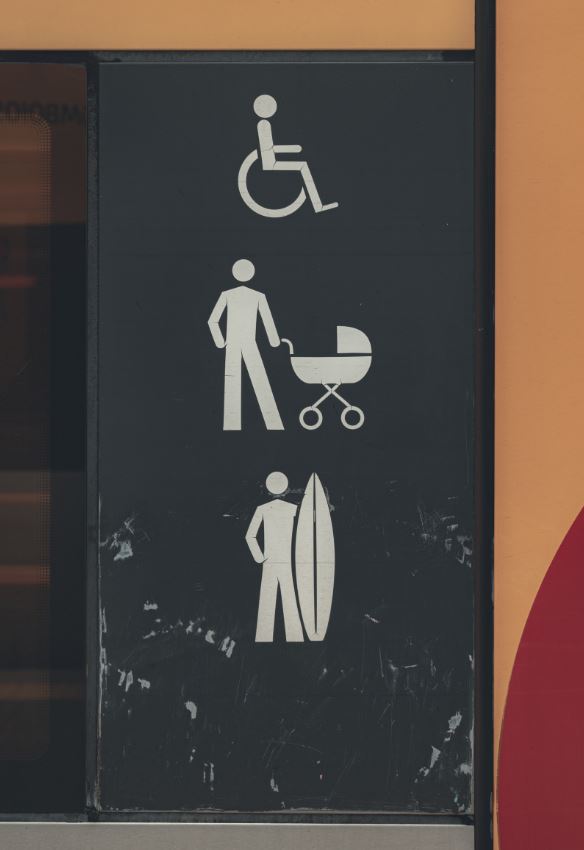
Tactile signage includes pictograms which must be at least 6” inches tall with raised characters. ADA sign requirements define a pictogram as a symbol that represents a physical object, idea, or word.
The International Symbol of Accessibility (ISA)
ADA symbols are used to show areas or paths for wheelchair access. The International Symbol of Access (ISA), must be present at accessible restrooms, entrances, parking, elevators, and more.
ADA Restroom Sign Requirements
Restrooms need lots of signage from the walls, to the doors, and the routes to said restroom. Overall, you have to be cognizant of ADA restroom sign requirements like height, placement, location, and more. Don’t cheap out on providing enough signs and make sure to hire an inspector to make sure your placement is correct!
ADA Bathroom Sign Height
Tactile ADA bathroom signs are required to be mounted 48” inches minimum to 60” inches maximum. ADA bathroom sign height is necessary to your signs being used for their intended purpose.
Wall Mounted Signs
On the latch side of your bathroom door, you are required to provide a tactile bathroom sign. This sign can not be in the path of a swinging door.
Geometric Door Signs (12" Circle and Triangle)
In some states and jurisdictions, there are ADA bathroom signage requirements for geometric door signs. There is no federal law regarding these ADA sign requirements, but some states such as California, in the California Building Code (CBC), require placement of a 12” inch circle or triangle on the door. ADA bathroom sign placement doesn’t have to be difficult if you build the right team of inspectors, architects, and contractors.
ADA Room Identification and Door Signage
ADA room signage requirements are just like the bathrooms and other areas but have some specific differences. These codes are very important to businesses such as hospitals, hotels, office buildings, and properties with several individualized rooms.
Room Numbers vs. Room Names
ADA room signage requirements were invented so people with visual or physical disabilities can read the signs and understand what room they’re in front of. Signs in these facilities should have raised characters and braille for room numbers and room names. Signs need proper height, tactile characters, and a clear floor space.
Conference Rooms, Break Rooms, and Other Areas
All areas that are accessible to the public need to be accessible to all. Areas like conference rooms, break areas, social seating, and food service areas must have proper directional signage in addition to service signs.
ADA Exit Sign and Stairwell Sign Requirements
ADA sign requirements will encompass the exit signs and signs at stairwells and elevators. These help with the navigation through a building and are essential in providing ease of use. It is a federal offense to deny access to a building because it’s not accessible. Make sure you check the requirements before installations or renovations.
Which Exit Doors Require Tactile Signs
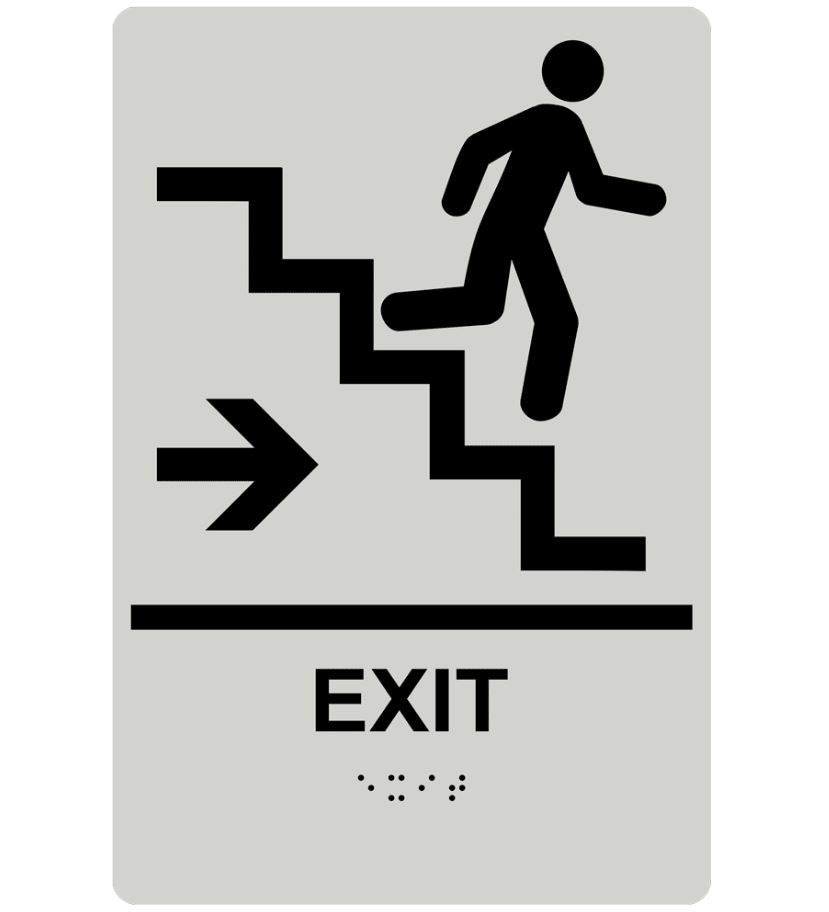
ADA exit signs are required at all doors that require tactile signs such as exit stair ways, passage ways, and exit discharges (§216.4.1).
ADA Signs vs. Illuminated Exit Signs
ADA exit signs have illuminated exit requirements that are separate from tactile requirements. They are different codes and do not substitute each other.
ADA Elevator Signage Requirements
Elevators need plenty of signs and signaling that help people navigate to different floors of a building. This includes floor labeling, sign placement, ADA sign height, and directional signage. All of these combined codes work together to help someone to get to different areas of a building. Want to learn more? Have a look at our deep dive on ADA elevator requirements.
Hoistway Floor Designations
Compliant ADA elevator signs will have 2” tall minimum raised characters on both jambs that are centered at 60” inches above the finish floor.
Car Controls and Emergency Devices
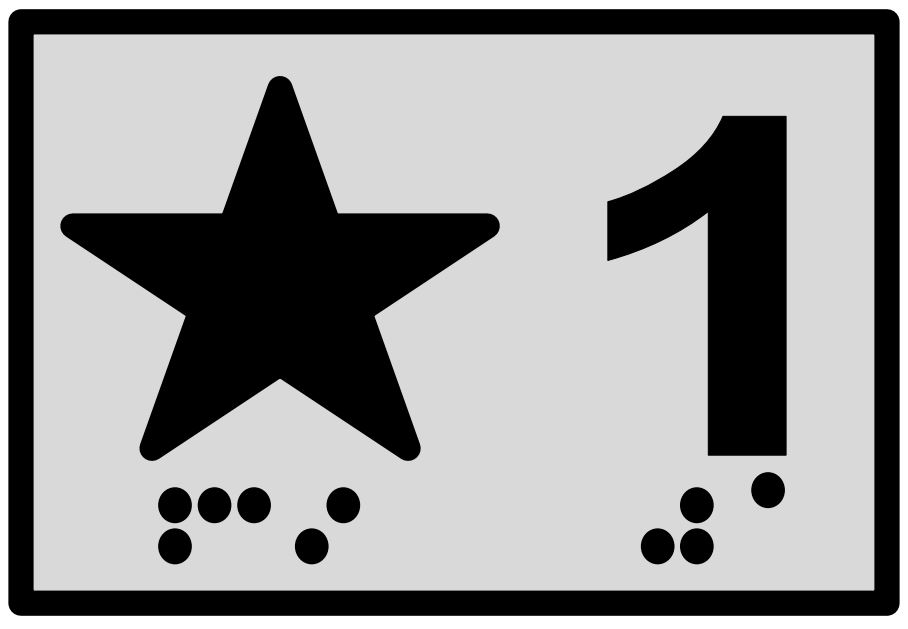
For car controls dealing with emergency devices, ADA elevator signage requirements do not specify standards for the standard 48″–60″ mounting range and are exempt.
ADA Wayfinding and Directional Signage
Wayfinding and directional signage refers to the signs used to navigate to different areas of a property or to find your way for a specific purpose. In the context of businesses, large properties like shopping centers, universities, hospitals, and office buildings greatly benefit from ADA compliant directional signage.
Directional Signs Need Contrast and Sizing, Not Braille
ADA directional signage requirements are not required to adhere to tactile rules. ADA wayfinding signs specifically focus on visual character fuels (§703.5).
Directional Signs to Accessible Entrances and Facilities
ADA wayfinding signs are required to entrances, restrooms, or elevators are not accessible. From here an individual can use the signs to determine an alternate route.
ADA Parking Sign Requirements
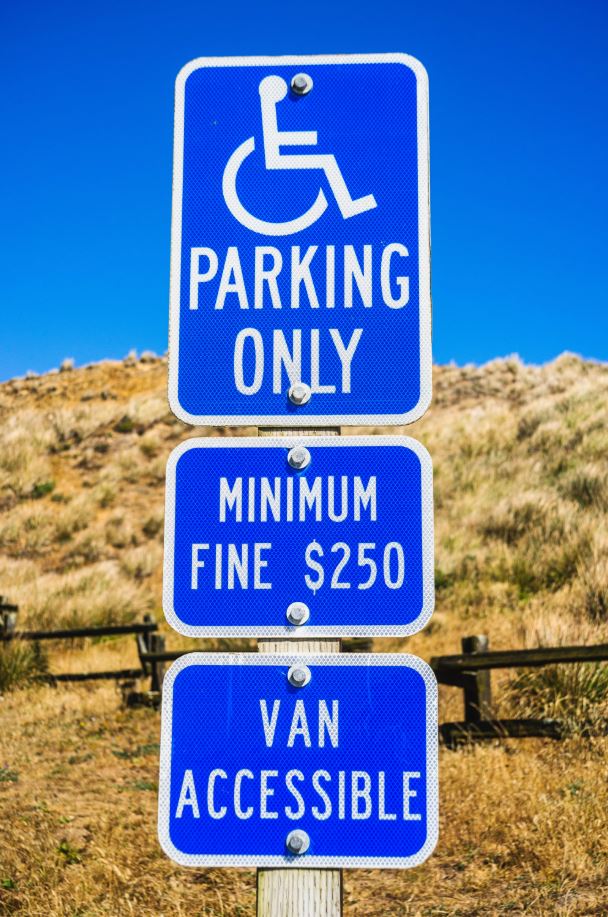
The bottom edge of parking signs are required to be 60” inches minimum above the ground. “Van Accessible” signs are not required for parking lots providing less than 4 total spaces. ADA parking signage will be required to be compliant and covers the placement of the signs, height of signs, protrusions they may create, and more. For the sake of this guide, we’ll stay surface level but make sure to hire an ADA consultant if you’re making changes to your parking to avoid doing the work over twice. A full guide on ADA parking requirements can be found here!
Federal & Civil ADA Penalties
The Americans with disabilities Act (ADA) is federal law associated with fines for ADA violations and subsequent violations. If you are a business owner or property manager and have experienced a “drive-by” lawsuit, you’re not alone. ADA related lawsuits are exploding in the United States. In order to prevent unnecessary lawsuits and limit your liability, you need to retain an ADA inspector, get an evaluation, and make the necessary changes to your property.
Common Questions
Frequently Asked Questions
What is the required height for ADA signs?
For tactile signs, the height range is 48” inches to 60” inches. Signs mounted differently have different standards.
Do all signs need Braille?
No, all signs do not need tactile braille. Reach out to an ADA inspector if you’re unsure if you need braille signs!
What height should a bathroom sign be mounted?
The bathroom door latch side sign is required to be mounted 48” inches minimum to 60” inches maximum.
Can ADA signs be mounted on the door?
ADA signs can be mounted on a door, just ensure it’s the correct sign and placement.
Do ADA signs have to be a specific color?
ADA signs in general don’t have to be a specific color, but do require a color contrast of the text/pictogram and background.
What font is required for ADA signs?
Sans serif font is required with specific spacing requirements. Reach out to a professional to determine proper sign font.