Most doors we flag on an ADA inspection are wide enough. They fail on the parts people actually touch: a round knob, a lock that needs a pinch and a twist, a closer that slams shut in two seconds, or a door that takes 15 pounds to push open. This guide covers the ADA door hardware requirements, door closer requirements and opening force limits in the 2010 ADA Standards, plus the stricter California rules in CBC Chapter 11B, with real photos from our 2026 inspections.
ADA door hardware requirements at a glance
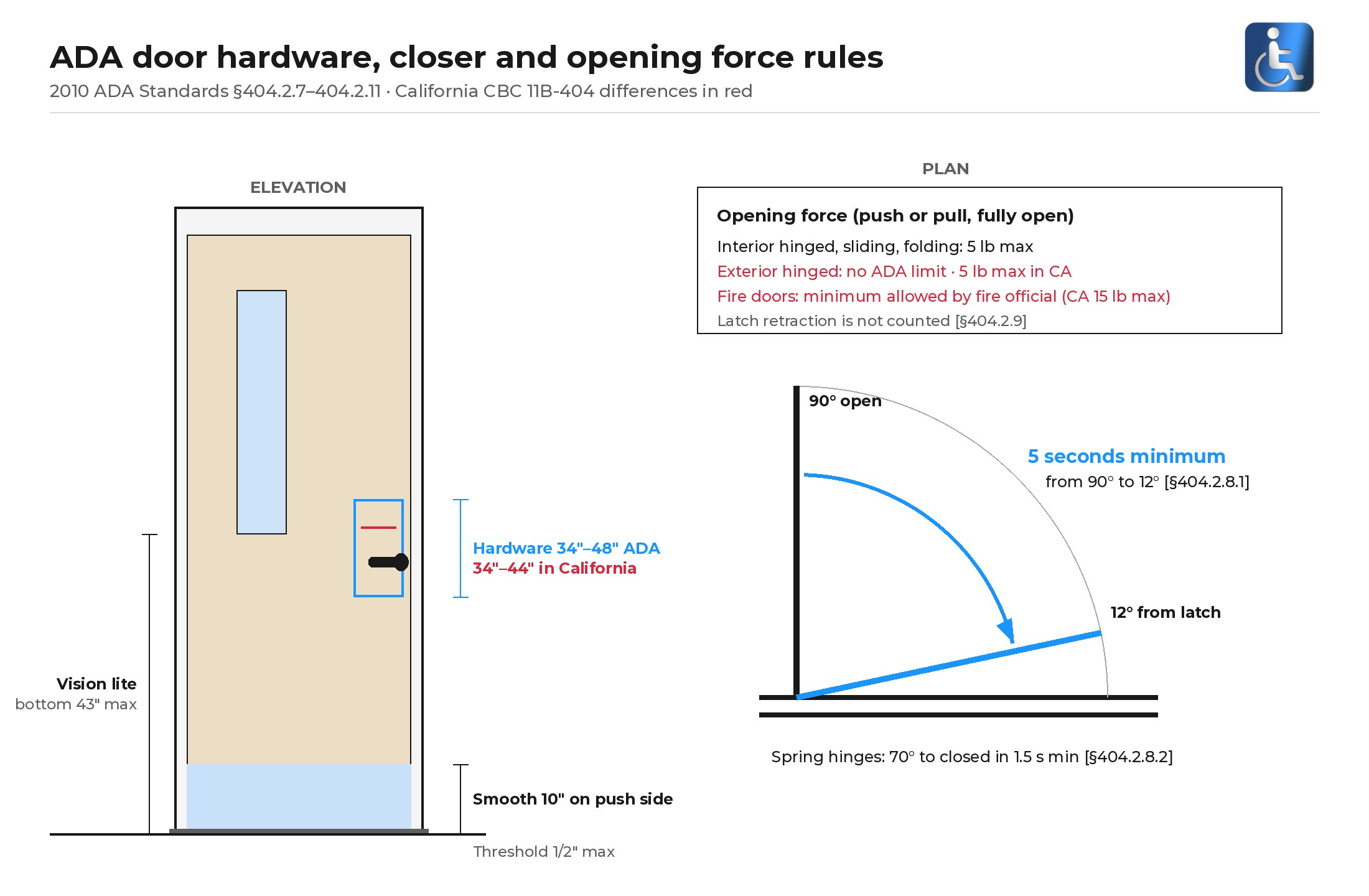
| Item | 2010 ADA Standards | California (CBC 11B) |
|---|---|---|
| Hardware shape | One hand, no tight grasping, pinching or twisting of the wrist [§404.2.7, §309.4] | Same [11B-404.2.7, 11B-309.4] |
| Hardware height | 34″ to 48″ above the floor | 34″ to 44″ |
| Force to operate the hardware | 5 lb max [§309.4] | 5 lb max |
| Door closer speed | 5 seconds min from 90° to 12° [§404.2.8.1] | Same |
| Spring hinges | 1.5 seconds min from 70° to closed [§404.2.8.2] | Same |
| Interior hinged door force | 5 lb max [§404.2.9] | 5 lb max |
| Sliding or folding door force | 5 lb max | 5 lb max |
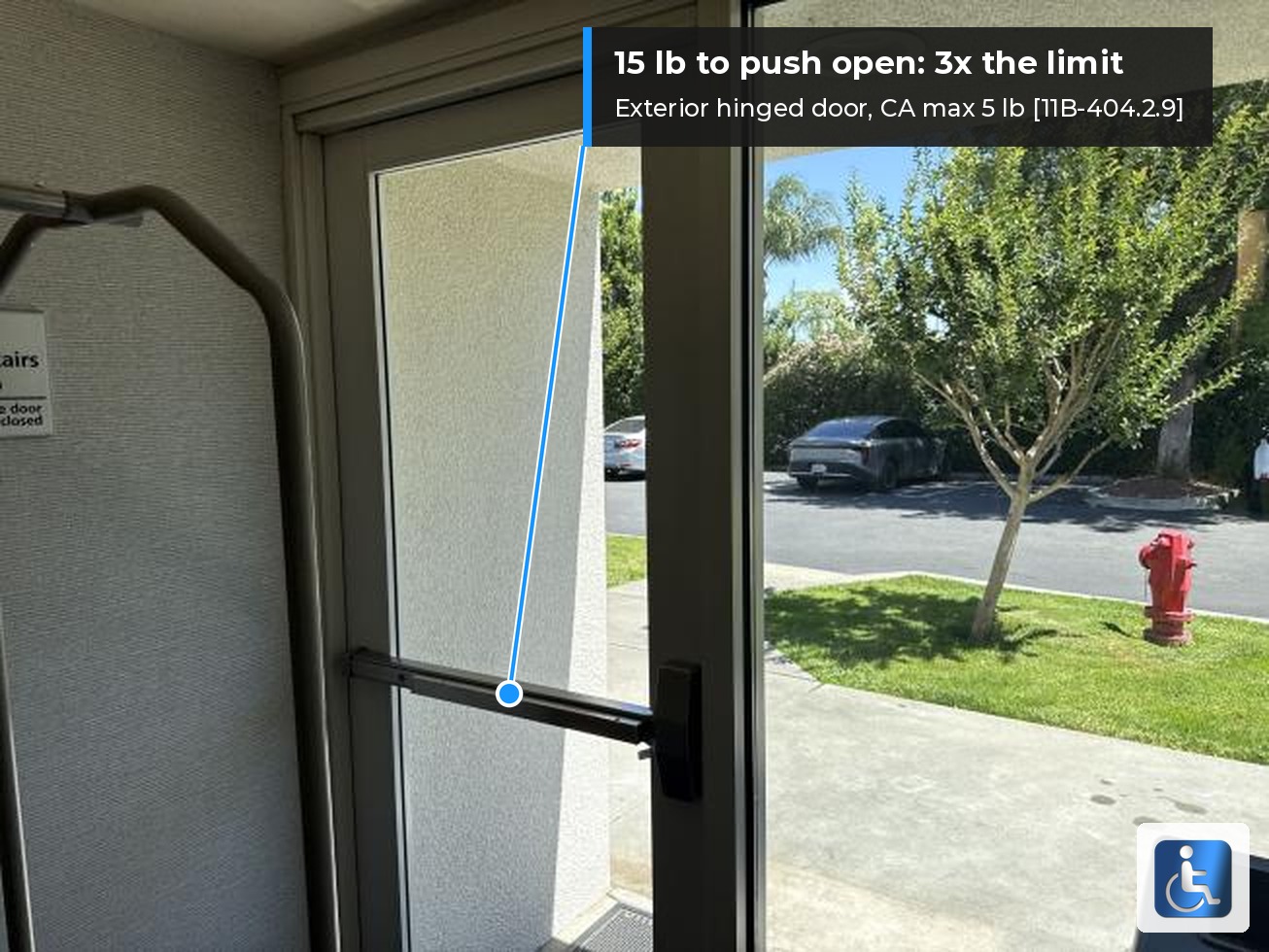
| Exterior hinged door force | No limit set | 5 lb max (8.5 lb allowed only with a powered door, see below) |
| Fire door force | Minimum the fire official allows | Same, 15 lb max |
| Bottom of door, push side | Smooth for 10″ [§404.2.10] | Same, plus free of sharp or abrasive edges; no existing-door exception |
| Vision lite (door glass) | Bottom of glass 43″ max [§404.2.11] | Same |
| Threshold | 1/2″ max [§404.2.5] | 1/2″ max |
Which doors have to comply?
Every door, doorway and gate on an accessible route has to meet §404 [§404.1]. That covers entrance doors, restroom and toilet stall doors, doors into dressing rooms, exam rooms, offices, hotel guest rooms and break rooms, and gates at pools and patios. At least 60% of public entrances must be accessible [§206.4.1], and the doors at those entrances carry all of these hardware, closer and force rules.
There is one narrow exception. Doors operated only by security personnel do not need to meet the hardware, closer and force rules [§404.1 Exception]. The Access Board says security has to control the door for everyone. If staff only open it for wheelchair users while everyone else walks through on their own, the exception does not apply. California adds a step: post a sign on the approach side that reads “Entry restricted and controlled by security personnel” [11B-404.1].
ADA door handle requirements
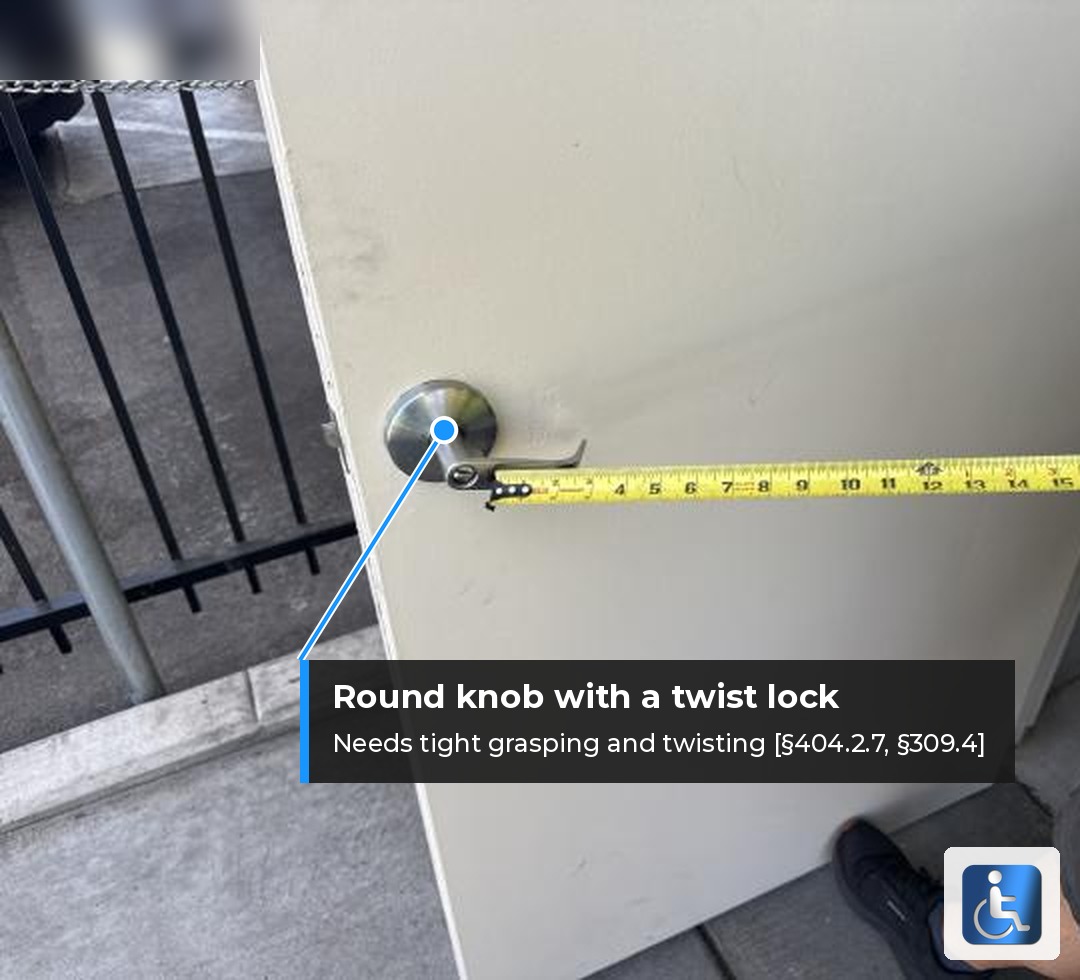
Handles, pulls, latches, locks and every other operable part on a door must be usable with one hand and must not need tight grasping, tight pinching or twisting of the wrist [§404.2.7, §309.4]. The Access Board’s advisory puts it simply: hardware that works with a closed fist or a loose grip serves the most people [Advisory 404.2.7].
In practice that means:
- Lever handles pass. So do push plates, push bars (panic hardware), and U-shaped or loop pulls you can hook a hand through.
- Round knobs fail. You have to grip and twist them, which is exactly what §309.4 bans.
- Twist locks, small thumb turns and pinch-type privacy buttons fail on restroom doors. A lever lockset with a push-button lock that releases when you turn the lever is the usual fix.
- Deadbolts count too. If the public or a hotel guest has to work it, it needs a lever-style or large thumb turn within the height range.
Toilet stall doors have their own hardware rule. A self-closing stall door needs a door pull on both sides, near the latch [§604.8.1.2]. Inspectors write this one up often because the inside pull is easy to forget. See our bathroom stall requirements for the rest of the stall rules.
California’s Fire Marshal also requires lever handles to curve back to within 1/2″ of the door so they don’t catch clothing during an evacuation [Advisory 11B-404.2.7, CCR Title 24 Part 12]. Most commercial levers already have this return.
ADA door handle height
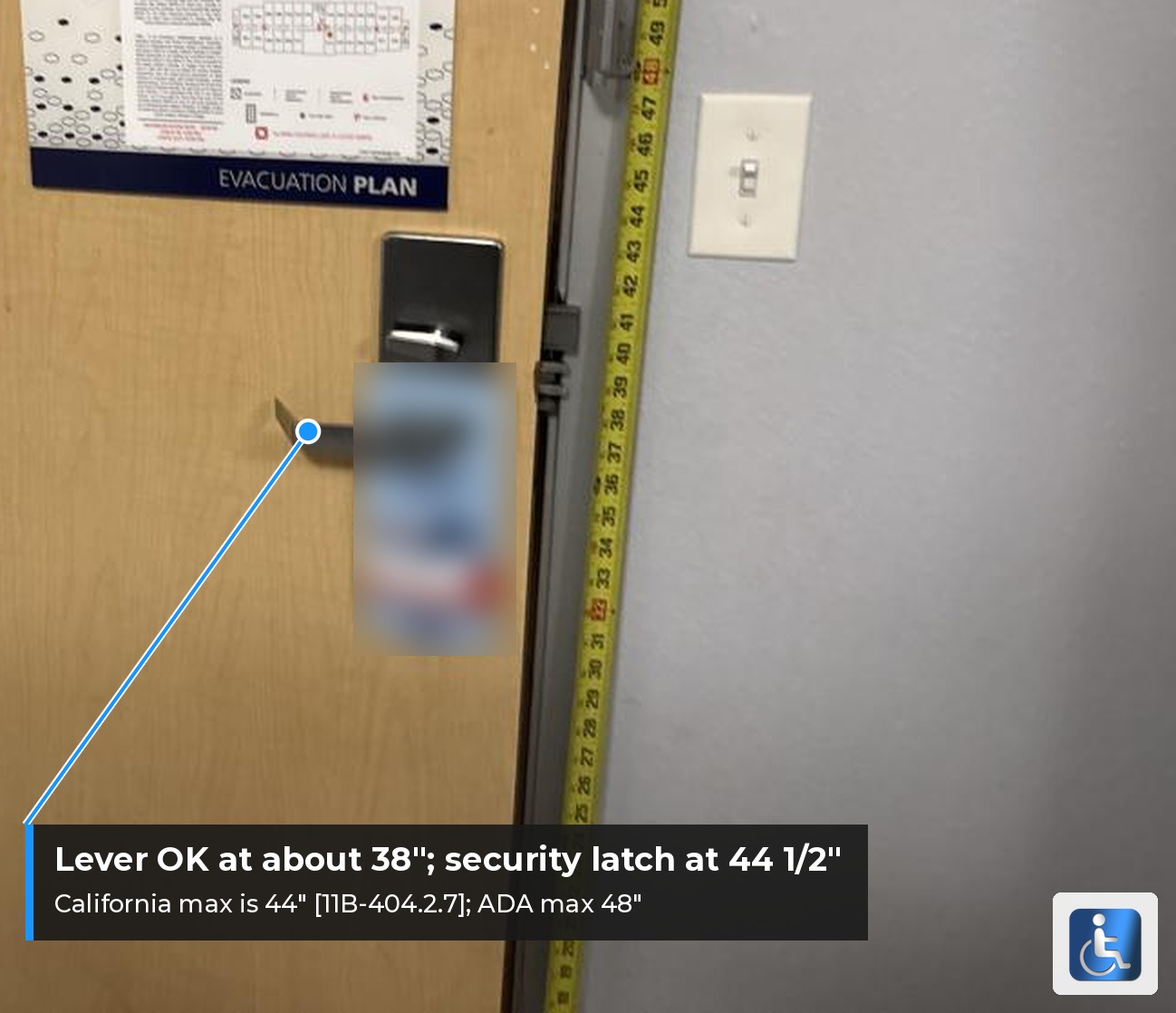
Operable parts of door hardware must be 34″ minimum and 48″ maximum above the floor under the ADA [§404.2.7]. California caps it lower, at 44″ [11B-404.2.7]. Measure to the part you actually operate: the lever, the thumb turn, the latch release, or the card reader slot on a hotel lock. A lever at 38″ can pass while a security latch on the same door fails at 44 1/2″.
Two exceptions apply in both codes:
- Existing locks may stay where they are on existing glass doors without stiles, overhead rolling doors and grilles, and similar doors whose locks only work at the top or bottom rail.
- Pool, spa and hot tub barrier gates may put the self-latching release as high as 54″, as long as the latch is not also a self-locking key, card or combination lock.
On sliding doors, the hardware must be exposed and usable from both sides when the door is fully open.
ADA door closer requirements
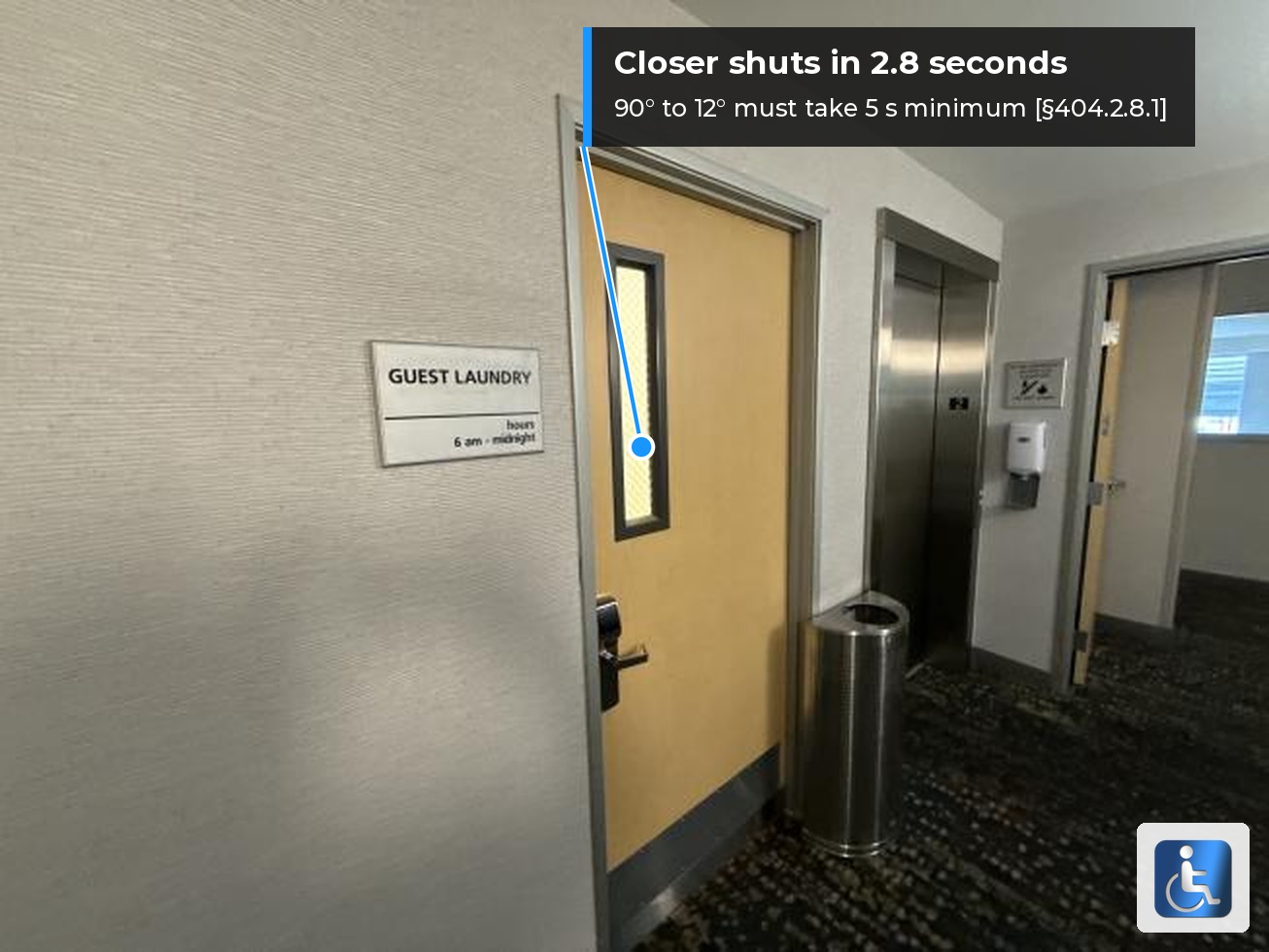
A door closer must be adjusted so that a door opened to 90° takes at least 5 seconds to swing to 12° from the latch [§404.2.8.1]. The last 12° is not timed, so the closer can snap the door shut at the end and still pass. The slower sweep gives a person using a wheelchair, walker or cane time to get through before the door swings into them.
Spring hinges, which close a door without a separate closer, must take at least 1.5 seconds to close from 70° [§404.2.8.2]. California uses the same numbers [11B-404.2.8].
How to check a closer:
- Open the door fully to 90° and let go.
- Start a stopwatch when you release it and stop when the door is about 12° (a few inches) from the frame.
- Under 5 seconds fails. Repeat a few times; closers drift with temperature.
The fix is usually free. Most commercial closers have a sweep speed valve and a latch speed valve. Turning the sweep valve slows the swing without changing the opening force. Slowing the sweep alone also will not fix a heavy door, because opening force is set by the closer’s spring size, not its speed.
Closers also cannot hang too low. Overhead clearance along an accessible route is 80″, but door closers and door stops may project down to 78″ above the floor [§307.4].
ADA door opening force
Under the 2010 ADA Standards, interior hinged doors, sliding doors and folding doors must open with no more than 5 pounds of force [§404.2.9]. Fire doors may use the minimum force the local fire official allows. The ADA sets no limit for exterior hinged doors, because wind, weather seals and building air pressure make a 5 lb exterior door hard to keep.
California is stricter. Under CBC 11B-404.2.9:
- Interior hinged doors and gates: 5 lb max.
- Sliding or folding doors: 5 lb max.
- Exterior hinged doors: 5 lb max.
- Required fire doors: the minimum the fire official allows, but never more than 15 lb.
California does give one escape hatch for exterior doors. If at least one of every eight exterior door leaves at the same entrance (or one, if there are fewer than eight) is a powered door, the other doors at that entrance serving the same space may go up to 8.5 lb. The powered leaf must be the one closest to the accessible route, must meet BHMA A156.10 or A156.19, needs backup power for 100 cycles if the building has 150 or more occupants, and needs push plates or other controls on both sides [11B-404.2.9 Exception].
What the 5 lb limit measures: the steady push or pull needed to swing the door fully open, not the first jolt to get it moving, and not the force to retract the latch [Advisory 404.2.9]. Inspectors use a door pressure gauge held at the latch side, perpendicular to the door.
What to do with a heavy door:
- Turn down the spring power on an adjustable closer, or swap in a closer sized for a lighter door.
- Check for binding: dragging thresholds, sagging hinges and tight weatherstripping add pounds.
- On exterior doors in California that cannot get under 5 lb, add a low-energy power operator (BHMA A156.19) with push plates.
ADA door push and pull requirements: the bottom 10 inches
The push side of a swinging door or gate must be smooth for the full width of the door from the floor up to 10″ [§404.2.10]. A wheelchair footrest often ends up pushing the door, and anything it can catch on (rails, louvers, mesh, a kick-down door stop) is a hazard. Joints in that band must be within 1/16″ of the same plane, and cavities behind added kick plates must be capped.
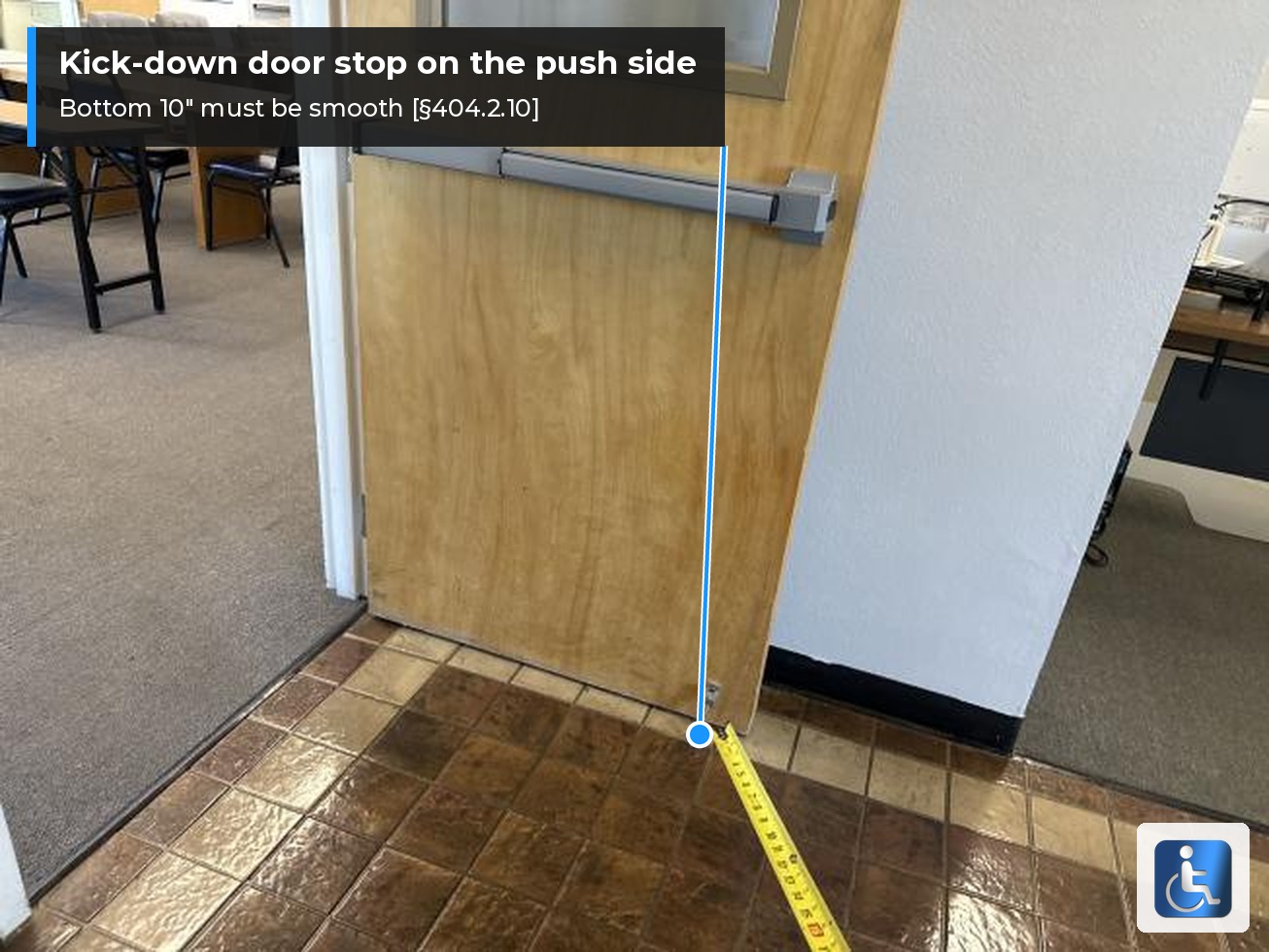
Exceptions under the ADA: sliding doors; stile-less tempered glass doors with a bottom rail tapered at least 60°; doors that stop more than 10″ above the floor; and existing doors without a smooth bottom, as long as any added kick plate is capped. California keeps the first three but makes the existing-door exception “Reserved,” so in California older doors with a raised panel or louver at the bottom still have to be fixed. California also requires the surface to be free of sharp or abrasive edges [11B-404.2.10].
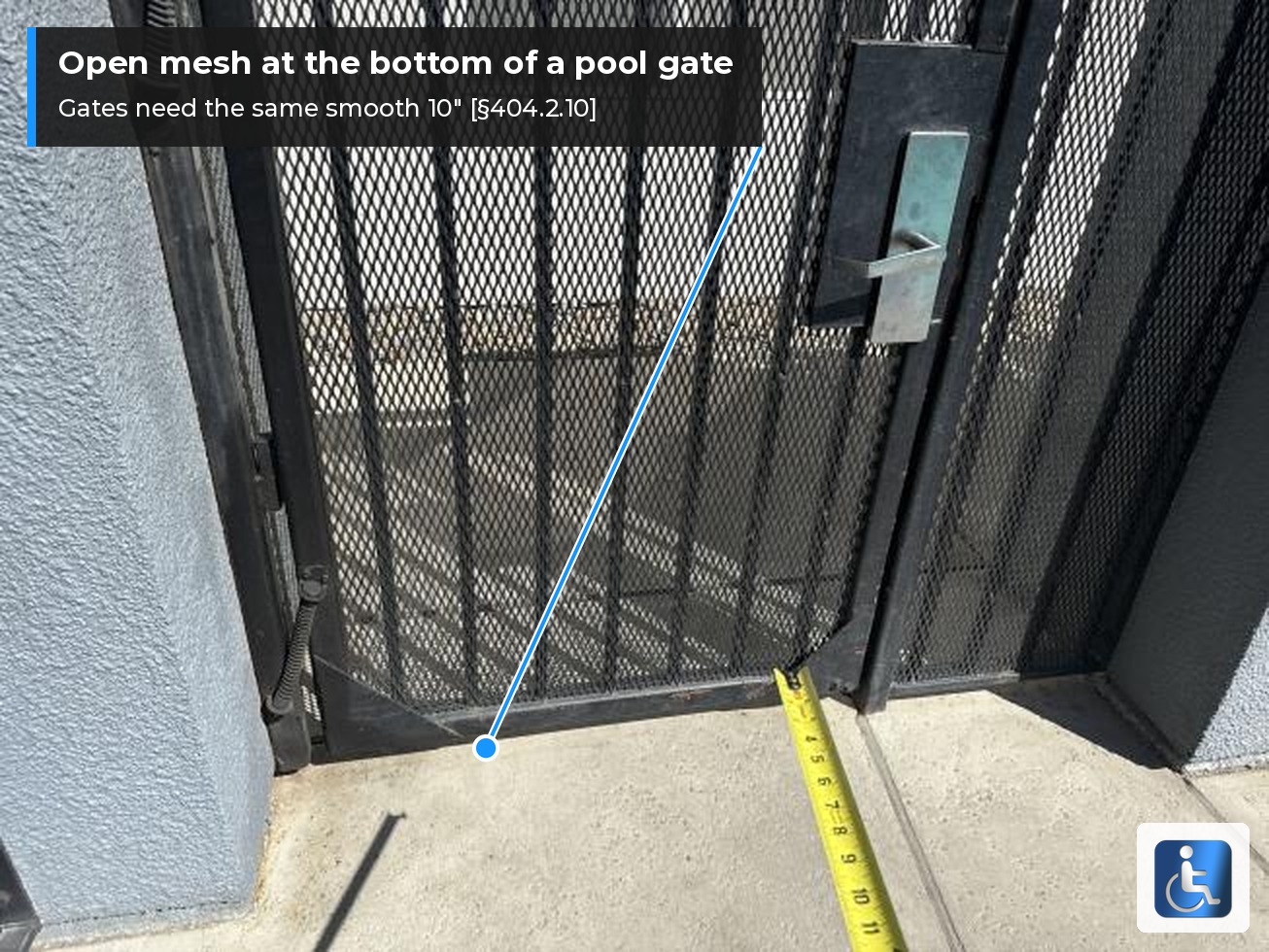
Gates follow the same rule. Pool gates, patio gates and fence gates with open mesh or pickets at the bottom need a solid kick plate on the push side.
Vision lites and other door glass
If a door or the sidelight next to it has glass meant for seeing through, the bottom of at least one glass panel must be 43″ max above the floor [§404.2.11]. This lets a seated person see someone on the other side. Glass that sits higher, such as a small square window at 60″, fails if it is the only vision panel.
Automatic and power-assisted doors
The ADA does not require automatic doors. When you install them, full-powered automatic doors must meet BHMA A156.10, and low-energy and power-assisted doors must meet BHMA A156.19 [§404.3]. The doorway needs 32″ clear in both power-on and power-off mode, manual controls (push plates) must meet the operable parts rules, and the clear space at a control has to be outside the door’s swing [§404.3.1, §404.3.5]. See our guide to operable parts for the control rules.
In California, push plates used for the 8.5 lb exception come in pairs: one centered 7″ to 8″ above the floor and one centered 30″ to 44″, each at least 4″ across and showing the International Symbol of Accessibility [11B-404.2.9 Exception].
Door hardware violations we find most often
- Closers that are too fast. One of the most common door findings on our reports, and almost always fixed with a screwdriver.
- Heavy doors. Readings of 7 to 10 lb on restroom doors and 12 to 17 lb on exterior doors are typical on our 2026 reports.
- Knobs and twist locks on single-user restrooms and older offices.
- Hardware too high in California, usually a deadbolt, security latch or card reader between 44″ and 48″ that would pass under the ADA.
- No smooth bottom: door stops, louvers and mesh gates.
- Missing inside pull on a toilet stall door.
Most of these are readily achievable fixes that cost little. A CASp inspection lists each one with the measurement, the code section and a fix, so your maintenance crew knows exactly what to change. For the other door rules (width, maneuvering clearance, thresholds and doors in a row), see our ADA door requirements and door width guides.