ADA Definitions › ADA room
What Is an ADA Room? ADA Hotel Room Meaning and Requirements
An ADA room is a hotel or motel guest room built so a guest with a disability can use it: a room with mobility features (wider clear spaces, a 60″ turning space, an accessible bathroom with a roll-in shower, transfer shower or accessible tub, and controls within reach) or a room with communication features for guests who are deaf or hard of hearing (visible alarms and visible signals for the door and phone) [2010 ADA Standards §§224, 806]. Hotels also call it an accessible room, a handicap room or an ADA compliant room. They all mean the same thing.
Most guests only see a sign on the door and a grab bar in the shower. The rules behind the label are more specific: how many rooms a property needs, which of them need a roll-in shower, how the rooms are spread across room types, and how they are booked. This page explains what an ADA room means and what our CASp inspectors measure when they walk one.
ADA room at a glance
| Question | Short answer | Rule |
|---|---|---|
| What is it? | A guest room with mobility features, communication features, or both | §806 |
| Who needs them? | Hotels, motels, inns and similar short-stay lodging | 28 CFR §36.104 |
| How many? | Set by the total number of guest rooms (Table 224.2 and Table 224.4) | §224 |
| Roll-in showers? | Required at 51 rooms and up under the ADA; from 2 rooms in California | Table 224.2, Table 11B-224.2 |
| Clear space at the bed | 30″ x 48″ on both sides of one bed (36″ wide in California) | §806.2.3, 11B-806.2.3 |
| Can the hotel charge more? | No surcharge for the accessible features | 28 CFR §36.301(c) |
What does ADA room mean?
The ADA Standards never use the words “ADA room”. They use “guest room with mobility features” and “guest room with communication features”, inside the rules for transient lodging. A guest room is a sleeping room in a hotel, motel, inn or similar place where people stay for a short time, generally 30 days or less [28 CFR §36.104].
So when a guest asks for an ADA room, they are asking for one of two kinds of room, and sometimes both:
| Type | Built for | Main features |
|---|---|---|
| Mobility features room [§806.2] | Guests who use a wheelchair, walker or scooter | Clear floor space at the bed, 60″ turning space, accessible bathroom with grab bars and a tub, transfer shower or roll-in shower, closet and controls within reach, accessible patio or balcony |
| Communication features room [§806.3] | Guests who are deaf or hard of hearing | Visible alarms, visible notification for a door knock or bell and for incoming calls, phone with volume control and an outlet within 48″ for a TTY |
A “hearing accessible room” is the communication features room. An “accessible room with roll-in shower” is a mobility features room whose bathroom has a curbless shower instead of a tub.
What makes a hotel room ADA compliant?
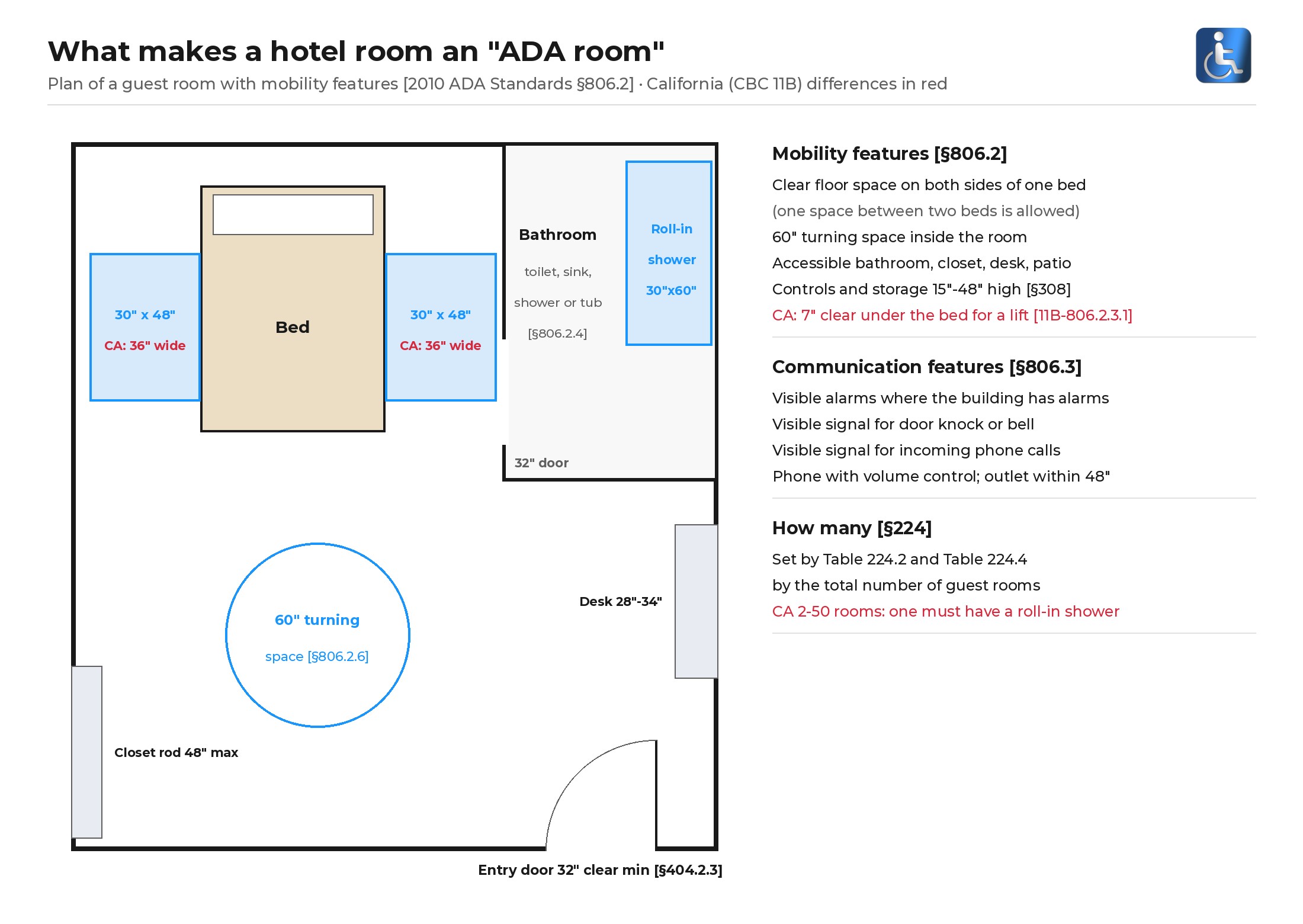
Mobility features [§806.2]
- Bed: a clear floor space of at least 30″ x 48″ on both sides of one bed, set for a parallel approach. Where there are two beds, one clear space between them is enough [§806.2.3].
- Turning space: a 60″ circle or T-shaped turning space inside the room [§806.2.6].
- Bathroom: at least one toilet, one lavatory and one tub or shower that meet the plumbing rules in §§603 to 610. If the standard rooms have vanity counter space, the accessible bathroom gets comparable space [§806.2.4, §806.2.4.1].
- Living, dining and exterior spaces such as patios, terraces and balconies that serve the room must be accessible [§806.2.1, §806.2.2].
- Kitchens and kitchenettes in the room follow the kitchen rules [§806.2.5, §804].
- Reach: closet rods, shelves, the iron, hooks, switches, the thermostat and window controls fall within 15″ to 48″ above the floor [§308, §225.2, §309].
Communication features [§806.3]
- Where the building has an emergency alarm system, the room has visible alarms [§806.3.1].
- Visible notification devices alert the guest to a door knock or bell and to incoming phone calls, and are not connected to the fire alarm strobes [§806.3.2].
- The phone has a volume control and an electrical outlet within 48″ to run a TTY [§806.3.2].
Doors in every room
Even rooms that are not ADA rooms need doors with a 32″ clear opening, including the bathroom door, so a guest who uses a wheelchair can visit a friend’s room [§224.1.2, §404.2.3]. Shower and sauna doors in standard rooms are the only exception.
How many ADA rooms does a hotel need?
The count depends on the total number of guest rooms. The two tables below are separate: a hotel needs both the mobility rooms and the communication rooms.
| Total guest rooms | Mobility rooms without roll-in shower | Mobility rooms with roll-in shower | Total mobility rooms | Communication rooms |
|---|---|---|---|---|
| 1 | 1 | 0 | 1 | 0 (1 in CA) |
| 2 to 25 | 1 | 0 | 1 | 2 |
| 26 to 50 | 2 | 0 | 2 | 4 |
| 51 to 75 | 3 | 1 | 4 | 7 |
| 76 to 100 | 4 | 1 | 5 | 9 |
| 101 to 150 | 5 | 2 | 7 | 12 |
| 151 to 200 | 6 | 2 | 8 | 14 |
| 201 to 300 | 7 | 3 | 10 | 17 |
| 301 to 400 | 8 | 4 | 12 | 20 |
| 401 to 500 | 9 | 4 | 13 | 22 |
| 501 to 1,000 | 2% of total | 1% of total | 3% of total | 5% of total |
| 1,001 and over | 20, plus 1 per 100 over 1,000 | 10, plus 1 per 100 over 1,000 | 30, plus 2 per 100 over 1,000 | 50, plus 3 per 100 over 1,000 |
Source: Table 224.2 and Table 224.4 of the 2010 ADA Standards. Table 224.4 starts at 2 rooms; California’s Table 11B-224.4 adds 1 communication room for a 1-room property.
Three rules change how the table is used:
- Overlap is limited. At least one mobility room must also have communication features, but no more than 10% of the mobility rooms may be counted toward the communication room total [§224.5]. A 275-room hotel needs 10 mobility rooms and 17 communication rooms; only 1 mobility room can count toward the 17, so 16 more rooms need communication features.
- Small buildings on one permit. Buildings on a common site under the same permit application that each have 50 or fewer rooms may be added together to find the count. Buildings with more than 50 rooms are counted separately [28 CFR §36.406(c)(1)].
- Alterations. When a hotel alters or adds rooms, the table applies to the rooms being altered or added until the property reaches the new construction count [§224.1.1].
Dispersion: ADA rooms in every room type
ADA rooms cannot all be the cheapest standard king on the ground floor. They have to be spread across the classes of rooms, with choices of room type, number of beds and amenities comparable to what other guests get [§224.5]. The Access Board lists room size, bed size, cost, view, bathroom fixtures such as hot tubs, and smoking or non-smoking as factors. When there are not enough ADA rooms to cover every class, the priority is room type first, then number of beds, then amenities.
Booking an ADA room: the reservation rules
Since March 15, 2012, places of lodging must handle accessible room reservations, by phone, online, in person or through a third party, the same way they handle other bookings [28 CFR §36.302(e)]. A hotel must:
- Let guests reserve accessible rooms during the same hours and in the same way as other rooms.
- Describe the accessible features of the hotel and its rooms in enough detail for a guest to decide on their own whether a room fits their needs.
- Hold accessible rooms for guests who need them until every other room of that type has been rented.
- Block a reserved accessible room so it is removed from all reservation systems.
- Guarantee the specific accessible room that was reserved.
A hotel also may not charge extra for an accessible room or its features [28 CFR §36.301(c)].
Which properties need ADA rooms?
Hotels, motels and inns are places of lodging under Title III. So is any other property that rents rooms for short stays, generally 30 days or less, with hotel-like service: reservations, walk-up or call-in rentals, housekeeping or linen service, and room types booked without a lease or deposit [28 CFR §36.104]. See ADA Title III for the full list of public accommodations.
Not covered: a building with 5 or fewer rooms for rent that the owner lives in [28 CFR §36.104], and residential units designed only for residential use. Apartments follow different rules; see ADA unit.
What our inspectors measure in an ADA room
An ADA inspection of a hotel checks the count and dispersion first, then walks each ADA room with a tape and a digital level. These are the items we write up most often:
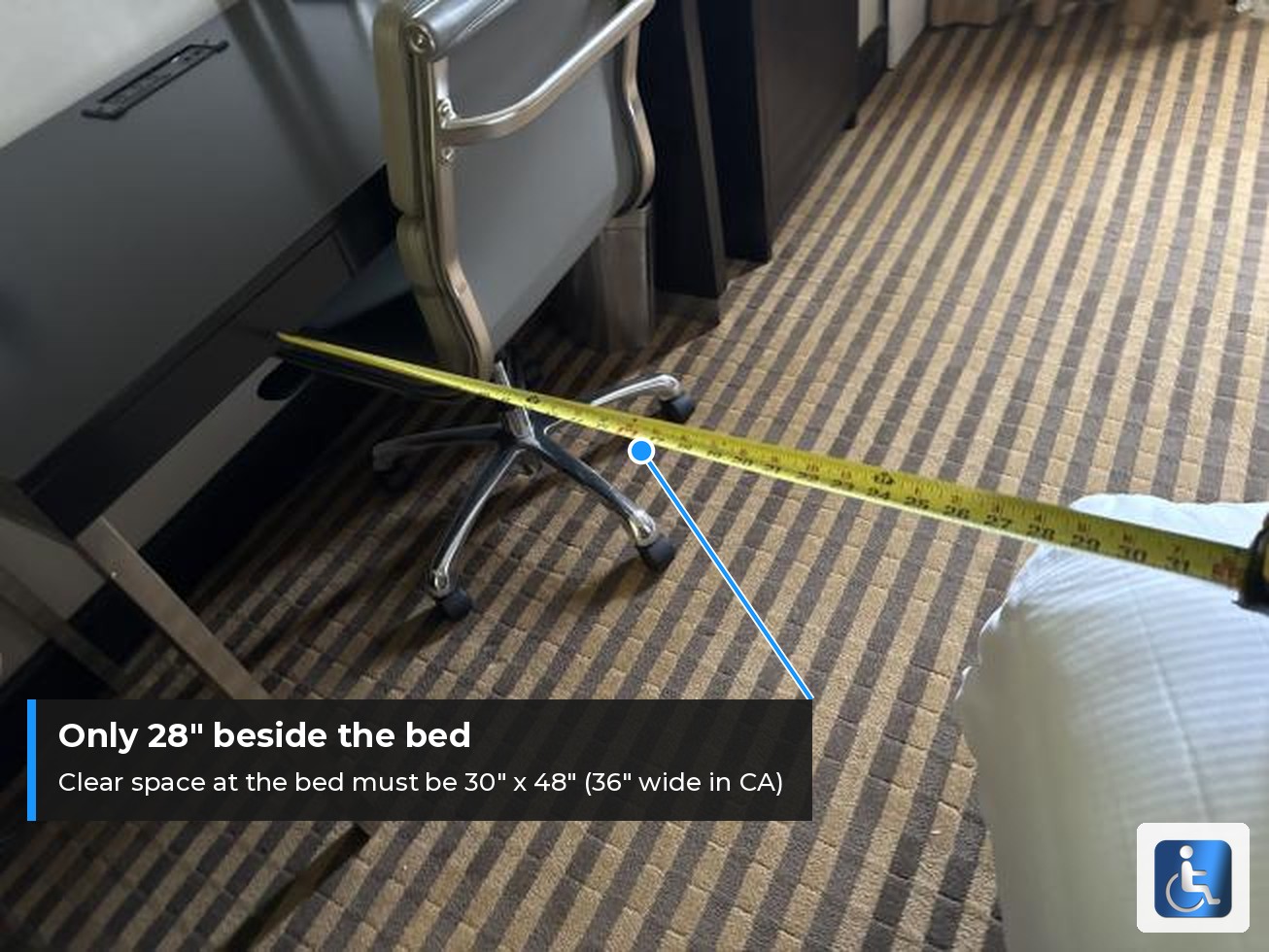
- Clear space beside the bed blocked by a nightstand, desk or chair.
- Closet rods, irons, hair dryers and hooks above 48″.
- Entry and bathroom doors with too little pull-side maneuvering clearance, closers that shut too fast, or a security latch above 48″ (44″ in California). See ADA door hardware requirements.
- Roll-in shower seats on the wrong wall, grab bars missing or above the seat, hand showers without a non-positive shut-off, and shower floors steeper than 1:48 (a California rule). See ADA shower requirements.
- Lavatory aprons too low for knee clearance and pipes left uninsulated.
- Phones without volume control and no visible door knock signal in the communication rooms.
- Blind wands, sliding door locks and lamp switches that need tight grasping or twisting.
The full checklist, room by room, is in our ADA hotel room requirements guide.
California: what CBC Chapter 11B adds
| Item | 2010 ADA Standards | California CBC 11B |
|---|---|---|
| Mobility rooms, 2 to 25 total rooms | 1 (no roll-in shower required) | 2: 1 with a roll-in shower and 1 with a tub or transfer shower [Table 11B-224.2] |
| Mobility rooms, 26 to 50 total rooms | 2 (no roll-in shower required) | 3: 1 with a roll-in shower and 2 with a tub or transfer shower |
| Communication rooms, 1-room property | None listed | 1 [Table 11B-224.4] |
| Clear space at the bed | 30″ x 48″ (§305) | 36″ x 48″ on both sides [11B-806.2.3] |
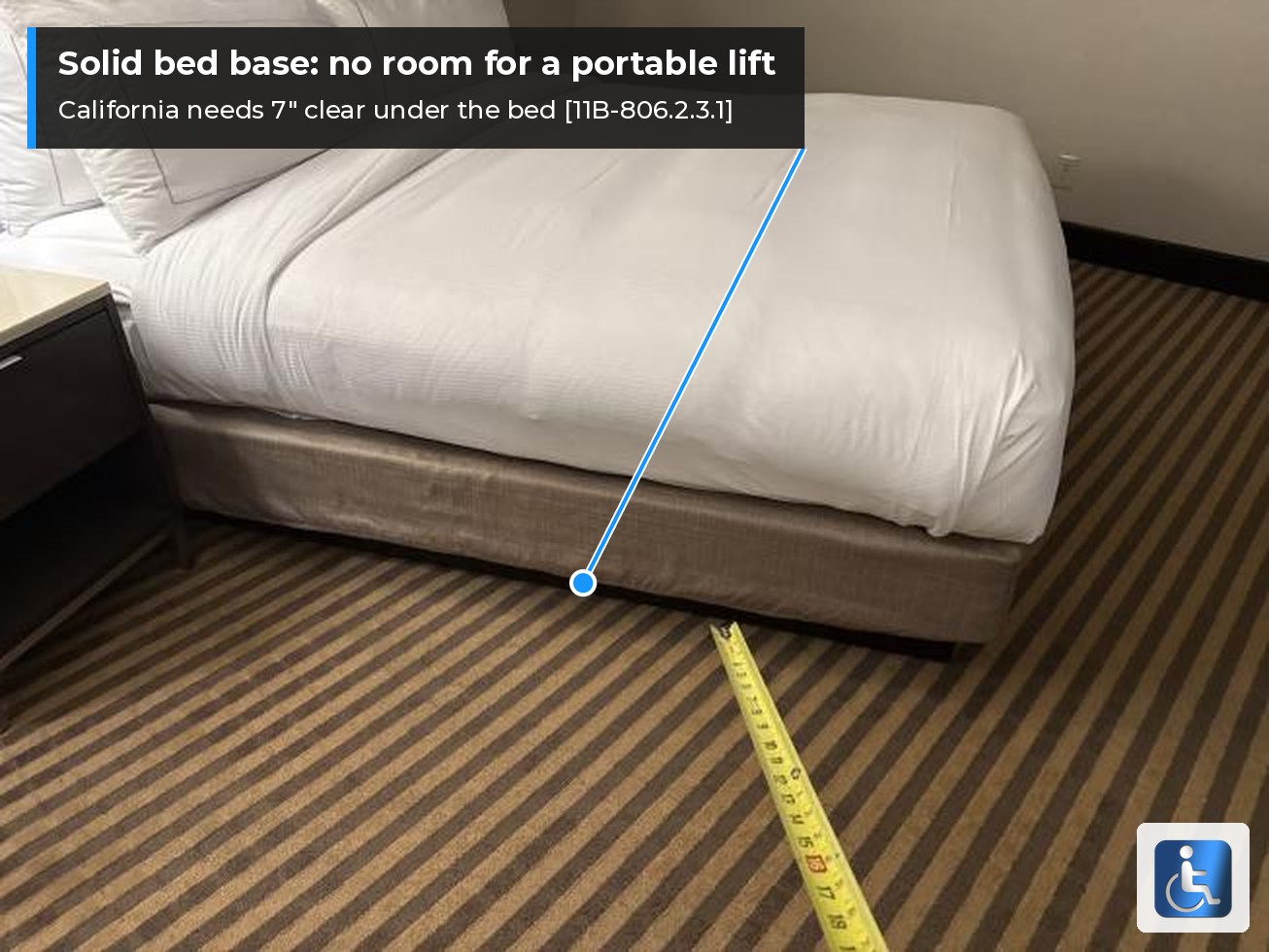
| Space under the bed | Not required | Clear space for a portable lift: at least 7″ high, 30″ deep under the bed and within 12″ of the head and foot [11B-806.2.3.1] |
| Range of rooms | Dispersion [§224.5] | Also spread across room sizes, costs and amenities [11B-224.1.3] |
| Door hardware height | 34″ to 48″ | 34″ to 44″ [11B-404.2.7] |
In California an ADA room violation is also a violation of the Unruh Civil Rights Act, which adds at least $4,000 in statutory damages per visit [Civ. Code §§51(f), 52(a)]. A CASp inspection before a claim is filed gives a hotel qualified defendant protections that can lower that amount.
Not sure your ADA rooms would pass?
Our CASp inspectors measure every ADA room, count your rooms against Table 224.2 and give you a written report with photos and fixes. Call (949) 339-9429.
Frequently asked questions
What is an ADA room?
An ADA room is a hotel guest room with mobility features, communication features or both, built to sections 224 and 806 of the 2010 ADA Standards so guests with disabilities can use the room, its bed area and its bathroom.
What does ADA room mean in a hotel?
It means an accessible guest room. A mobility room has extra clear space, a 60″ turning space and an accessible bathroom with a tub, transfer shower or roll-in shower. A communication room has visible alarms and visible signals for the door and phone for guests who are deaf or hard of hearing.
Does every ADA room have a roll-in shower?
No. Under the ADA, roll-in shower rooms start at 51 guest rooms; the other mobility rooms may have an accessible tub or a 36″ x 36″ transfer shower. California requires a roll-in shower room at properties with 2 or more guest rooms.
Can anyone book an ADA room?
Hotels must hold accessible rooms for guests who need them until all other rooms of that type are rented. After that, the hotel may rent the accessible room to anyone [28 CFR §36.302(e)(1)(iii)].
Can a hotel charge more for an ADA room?
No. A public accommodation may not add a surcharge to cover the cost of accessible features or barrier removal [28 CFR §36.301(c)].
How many ADA rooms does a 100-room hotel need?
Five mobility rooms (one with a roll-in shower) and nine communication rooms. At least one mobility room must also have communication features.
Sources: 2010 ADA Standards for Accessible Design §§224, 225.2, 304, 305, 308, 404.2.3, 603–610, 806; 28 CFR §§36.104, 36.301(c), 36.302(e), 36.406(c); 2025 California Building Code Chapter 11B (11B-224, 11B-404.2.7, 11B-806.2.3, 11B-806.2.3.1); California Civil Code §§51, 52. Written for property owners and managers, not as legal advice.