ADA Definitions › Unruh Civil Rights Act
Unruh Civil Rights Act: What It Means for ADA Lawsuits in California
The Unruh Civil Rights Act is the California law that entitles every person, regardless of disability and other protected traits, to full and equal treatment in all business establishments of every kind, and it makes any violation of the federal ADA a violation of Unruh as well [Cal. Civil Code §51(b), §51(f)]. What makes it matter to business owners is the money: Unruh adds statutory damages of at least $4,000 per occasion plus attorney’s fees [Civ. Code §52(a)], which the ADA itself does not allow private plaintiffs to collect.
That combination is why California sees more accessibility lawsuits than any other state. A ramp that is too steep or a restroom grab bar in the wrong place is an ADA violation, and in California it is also a $4,000 Unruh claim. This page explains what the Unruh Act is, how it ties to the ADA, what it costs, and what a CASp inspection does to the numbers.
Unruh Act at a glance
| Question | Short answer | Law |
|---|---|---|
| What is it? | California’s civil rights law for all business establishments | Civ. Code §51 |
| Link to the ADA | Every ADA violation is also an Unruh violation | §51(f) |
| Minimum damages | $4,000 per occasion, plus attorney’s fees | §52(a) |
| Per violation or per visit? | Per occasion the plaintiff was denied access, not per barrier | §55.56(f) |
| Reduced damages | $1,000 or $2,000 minimum if barriers are fixed in time and conditions are met | §55.56(g) |
| Companion law | California Disabled Persons Act, $1,000 minimum, not combined with Unruh for the same act | §§54, 54.1, 54.3 |
What is the Unruh Civil Rights Act?
The Unruh Act is Section 51 of the California Civil Code. It says that all persons in California are free and equal and, no matter their sex, race, color, religion, ancestry, national origin, disability, medical condition, genetic information, marital status, sexual orientation, citizenship, primary language or immigration status, are entitled to “the full and equal accommodations, advantages, facilities, privileges, or services in all business establishments of every kind whatsoever” [§51(b)].
It reaches far beyond buildings. It covers how a business treats people, from refusing service to unequal prices. For accessibility, though, nearly every case rests on one sentence: “A violation of the right of any individual under the federal Americans with Disabilities Act of 1990 … shall also constitute a violation of this section” [§51(f)].
How Unruh ties to the ADA
Because of §51(f), a plaintiff does not have to prove a separate California violation. Showing a barrier that breaks the ADA Title III rules is enough to prove an Unruh violation. The California Supreme Court held in Munson v. Del Taco, Inc. (2009) 46 Cal.4th 661 that a plaintiff whose Unruh claim rests on an ADA violation does not have to prove the discrimination was intentional.
The Act does not by itself require construction beyond what other laws require [§51(d)]. The building rules come from the 2010 ADA Standards and, in California, from CBC Chapter 11B.
Who counts as disabled under Unruh?
Unruh uses the definitions of disability in the California Fair Employment and Housing Act [§51(e)(1), Gov. Code §§12926, 12926.1]. California’s definition is broader than the federal one: a condition only has to limit a major life activity, not substantially limit it [Gov. Code §12926.1(c)].
Unruh Act damages: why claims cost so much
The ADA lets a private plaintiff win an order to fix the barrier and attorney’s fees, but not money damages. Unruh adds money:
| Remedy | Federal ADA Title III | Unruh Civil Rights Act |
|---|---|---|
| Order to remove barriers | Yes [42 USC §12188] | Yes |
| Money damages to the plaintiff | No (private suits) | Actual damages up to 3x, never less than $4,000 per offense [§52(a)] |
| Attorney’s fees | Yes [42 USC §12205] | Yes [§52(a)] |
Per occasion, not per violation
California counts statutory damages by visit. A plaintiff recovers for each particular occasion they were denied full and equal access, not for the number of barriers found on the property [§55.56(f)]. Ten violations seen on one visit are one $4,000 claim, not $40,000. A plaintiff qualifies only if they personally encountered the barrier and it caused difficulty, discomfort or embarrassment, or if they knew of it and were deterred from a visit they intended to make [§55.56(a)–(d)].
Technical violations
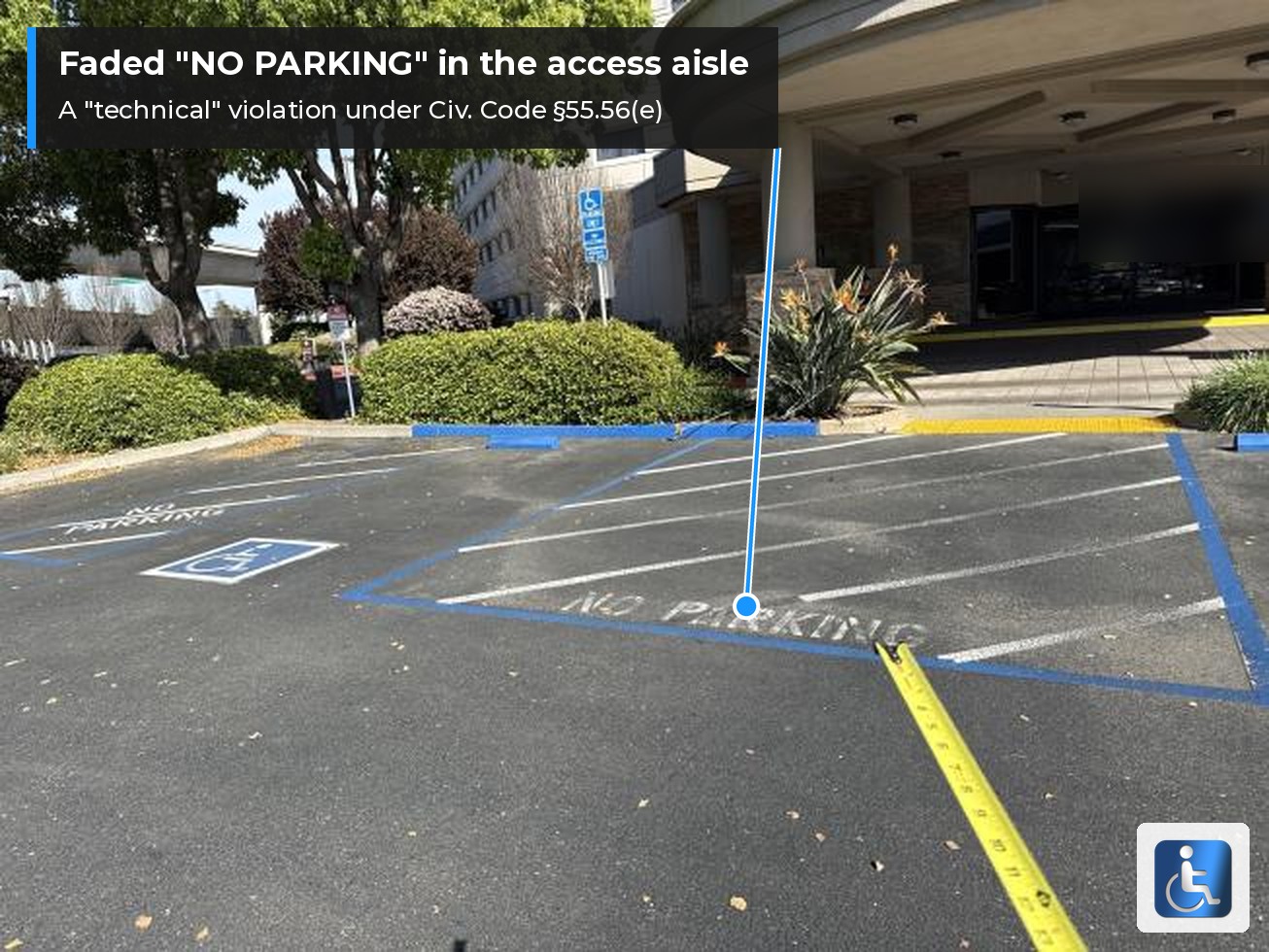
For a small business that fixes them within 15 days of being served or receiving written notice, some items are presumed not to cause difficulty, discomfort or embarrassment, which takes away the minimum damages unless the plaintiff proves otherwise [§55.56(e)]. The list includes interior signs, the order or wording of parking signs, the color of parking signs and striping, faded or chipped paint in otherwise compliant parking spaces and access aisles, and detectable warnings on ramps that do not cross a vehicle route.
How a CASp inspection lowers Unruh damages
California gives businesses that have had a CASp inspection some of the strongest protections in the law. All of them are in Civil Code §55.56(g) and §55.54:
| Protection | Who qualifies | Result |
|---|---|---|
| $1,000 minimum per offense | Site was CASp inspected before the visit in the claim, and all violations are fixed within 60 days of being served [§55.56(g)(1)] | Minimum drops from $4,000 to $1,000 |
| $2,000 minimum per offense | Small business: 25 or fewer employees and under $3.5 million average gross receipts (adjusted), fixes all violations within 30 days of being served [§55.56(g)(2)] | Minimum drops to $2,000, with or without a CASp |
| No minimum damages for 120 days | Business with 50 or fewer employees, for violations noted in a CASp report, if fixed within 120 days of the inspection [§55.56(g)(3)] | No minimum statutory damages for those items |
| Stay and early evaluation conference | A “qualified defendant” with a CASp inspection before the lawsuit is served [§§55.52(a)(8), 55.54] | Case paused for 90 days and an early court conference |
These reductions do not apply to intentional violations and do not change actual damages [§55.56(g)(6), (g)(7)]. The 120-day protection can be used once per area inspected unless the area is later altered [§55.56(g)(4)]. For a business that has already been sued, see ADA defense attorney vs CASp: who to call first.
The California Disabled Persons Act
The California Disabled Persons Act (Civil Code §§54 to 55.3) gives people with disabilities the right to full and free use of streets, sidewalks, public buildings, medical facilities and other public places, and full and equal access to hotels, places of public accommodation and other places the public is invited [§§54(a), 54.1(a)]. Like Unruh, it makes an ADA violation a violation of state law [§54(c), §54.1(d)].
Its minimum damages are $1,000 per offense [§54.3(a)]. A plaintiff cannot recover under both the Disabled Persons Act and Unruh for the same act [§54.3(c)], so most choose Unruh’s higher minimum.
Unruh lawsuits and demand letters
Most Unruh accessibility claims start one of two ways: a demand letter or a lawsuit filed without warning. California regulates both.
- Demand letters must describe each barrier in plain language, how it interfered with access, and the date of each visit [§55.31(a)]. The attorney must include a State Bar number and send a copy to the California Commission on Disability Access within five business days [§55.32(a)]. See ADA demand letter.
- High-frequency litigants, plaintiffs who filed 10 or more accessibility complaints in the past 12 months, pay an extra $1,000 filing fee in state court and face added pleading rules [Code Civ. Proc. §425.55; Gov. Code §70616.5].
- Federal court. Many ADA cases in California pair a federal ADA claim with a state Unruh claim. Federal judges in California increasingly decline to hear the Unruh part, which pushes more of these claims into state court.
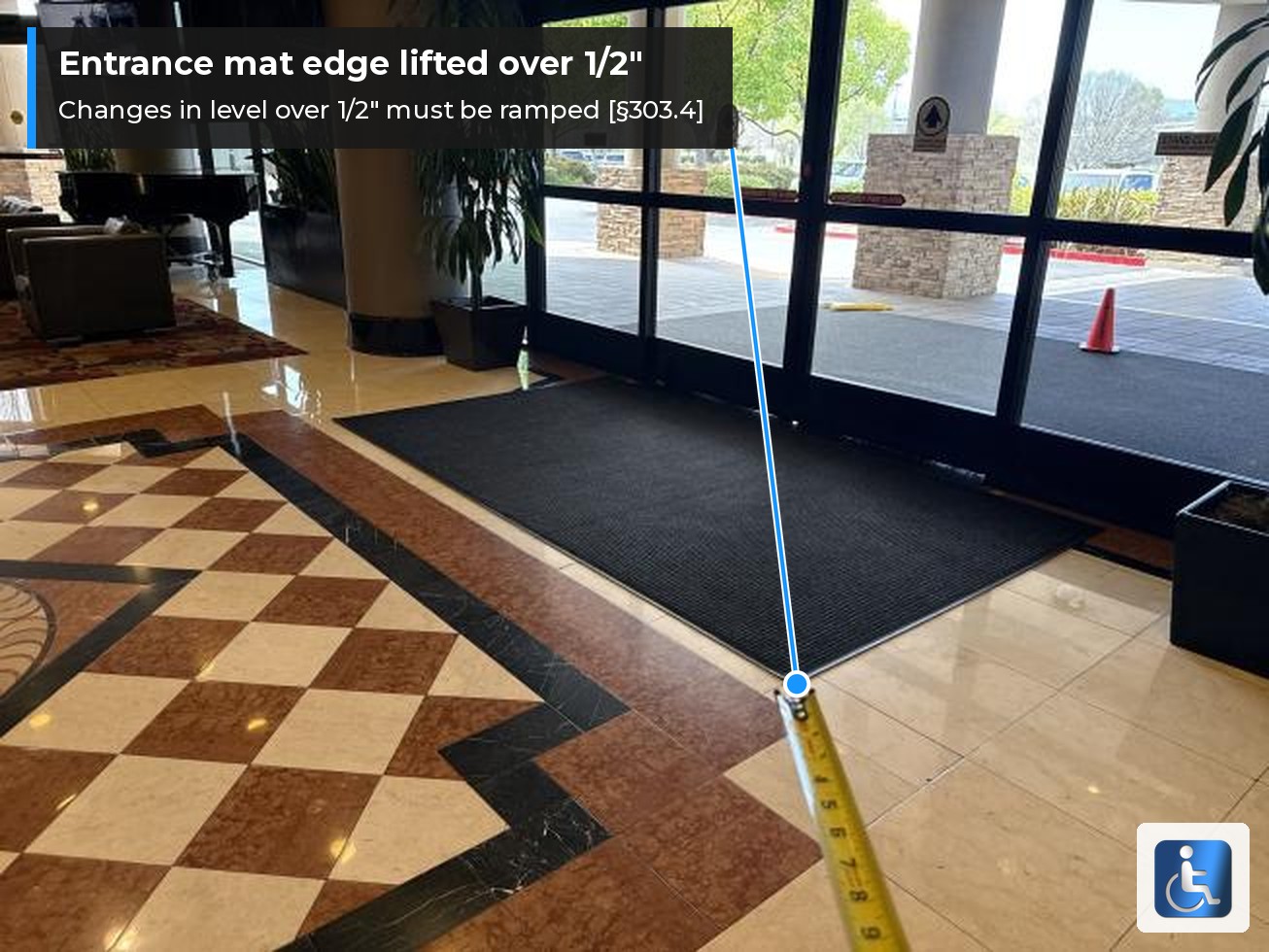
What plaintiffs list most often are the same items our inspectors find: parking, the route from parking to the entrance, entrance doors and thresholds, sales counters and restrooms.
How to lower your Unruh risk
- Get a CASp inspection. It finds the barriers before a plaintiff does and gives you the qualified defendant protections above. Our ADA inspection reports list each finding with a photo, the code section and the fix.
- Fix in priority order. Parking and the route to the entrance first, then the entrance, then the areas where you sell goods and services, then restrooms [28 CFR §36.304(c)].
- Keep records. Dates of the inspection, the report and each repair are what qualify you for the $1,000 minimum or the 120-day window.
- Re-inspect after alterations. Work on an area resets the 120-day protection only if you get a new CASp inspection within 30 days of final approval [§55.56(g)(4)].
- Check your lease. Commercial leases must state whether the space has been CASp inspected [Civ. Code §1938]. See ADA law in California.
Lower your Unruh Act exposure
A CASp inspection documents your site, lists every fix and gives you qualified defendant status in California. Call (949) 339-9429.
Frequently asked questions
What is the Unruh Civil Rights Act?
It is California Civil Code §51, which guarantees full and equal accommodations in all business establishments regardless of disability and other protected traits. Subsection (f) makes every ADA violation an Unruh violation.
How much is an Unruh Act violation?
At least $4,000 per occasion the plaintiff was denied access, up to three times actual damages, plus attorney’s fees [Civ. Code §52(a)]. The minimum can drop to $1,000 or $2,000 if the business qualifies under §55.56(g) and fixes the barriers in time.
Is the Unruh Act the same as the ADA?
No. The ADA is federal and gives private plaintiffs barrier removal and attorney’s fees but no damages. Unruh is California law, covers more than disability and adds statutory damages. An ADA violation is automatically an Unruh violation.
Does the Unruh Act apply to every business?
It applies to “all business establishments of every kind whatsoever” in California, so retail stores, restaurants, hotels, offices open to the public and service businesses are all covered.
What is the difference between the Unruh Act and the California Disabled Persons Act?
Both make ADA violations state law violations. Unruh’s minimum damages are $4,000 per offense; the Disabled Persons Act’s are $1,000 [§54.3(a)]. A plaintiff cannot collect under both for the same act.
Does a CASp inspection stop an Unruh lawsuit?
It does not stop someone from filing, but it can pause the case for 90 days with an early evaluation conference, and it can lower the minimum damages to $1,000 per offense, or to zero for 120 days for smaller businesses, if the conditions in §55.54 and §55.56(g) are met.
Sources: California Civil Code §§51, 52, 54, 54.1, 54.3, 55.31, 55.32, 55.52, 55.54, 55.56, 1938; Code of Civil Procedure §425.55; Government Code §§12926, 12926.1, 70616.5; 42 USC §§12188, 12205; 28 CFR §36.304; Munson v. Del Taco, Inc. (2009) 46 Cal.4th 661. Written for property owners and managers, not as legal advice. Talk to an attorney about any lawsuit or demand letter.