ADA Definitions › ADA compliant meaning
What Does ADA Compliant Mean? Buildings, Businesses and Websites Explained
ADA compliant means that a building, business or website meets the requirements of the Americans with Disabilities Act: for a building, every element and space the law requires to be accessible meets the technical rules in the 2010 ADA Standards for Accessible Design (and, in California, Chapter 11B of the California Building Code) [28 CFR §36.406]. In plain terms, a person with a disability can park, get in, move through, use the restroom, reach the counter and read the signs on the same terms as everyone else.
The phrase gets used loosely. A contractor says a ramp is “ADA compliant,” a listing says a hotel room is “ADA compliant,” a web agency says a site is “ADA compliant.” Each of those means something different, and only one of them has a number attached. This page explains what the term actually requires, who has to meet it, how you find out whether you do, and what happens if you don’t. Our inspectors are licensed Certified Access Specialists (CASp), so the definitions here are the ones used in an inspection report.
What “ADA compliant” means for a building
For a physical place, ADA compliance has two layers, and a property has to pass both:
- Scoping tells you which elements must be accessible and how many: for example, one in every six accessible parking spaces must be van accessible [ADA Standards §208.2.4], and at least 60 percent of public entrances must be accessible [§206.4.1].
- Technical requirements tell you what each of those elements must measure: a 60-inch turning space in the restroom [§304.3.1], a 32-inch clear door opening [§404.2.3], 5 pounds of force to open an interior door [§404.2.9], a 1:12 ramp slope [§405.2].
Both layers are in the 2010 ADA Standards, which became mandatory for new construction and alterations on March 15, 2012. Existing buildings that were never altered are not held to the full Standards; instead, a public accommodation must remove barriers where doing so is readily achievable [28 CFR §36.304]. So “ADA compliant” for a 1985 strip mall and for a 2024 restaurant are measured against different rules, which is one reason owners get conflicting answers.
California: ADA compliant is not enough on its own
In California, a building also has to meet Chapter 11B of the California Building Code (Title 24). Chapter 11B follows the 2010 Standards but is stricter in many places, and where the two differ the stricter rule applies. Examples a property owner feels directly:
| Element | 2010 ADA Standards | California CBC 11B |
|---|---|---|
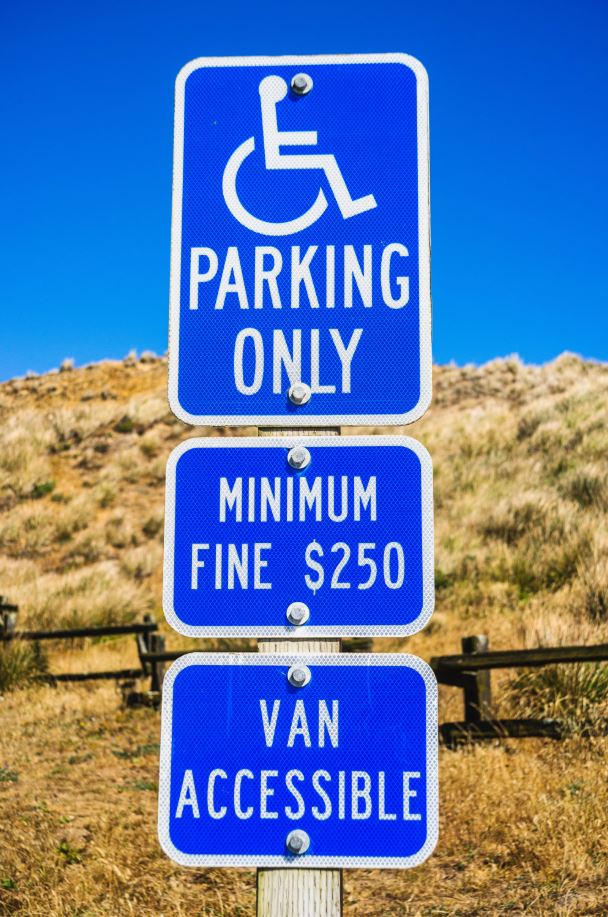
| Accessible parking stall | 96″ wide (van 132″, or 96″ with a 96″ aisle) [§502.2] | 108″ wide (van 144″), 216″ long, plus a “Minimum Fine $250” sign and a tow-away sign at the lot entrance [11B-502] |
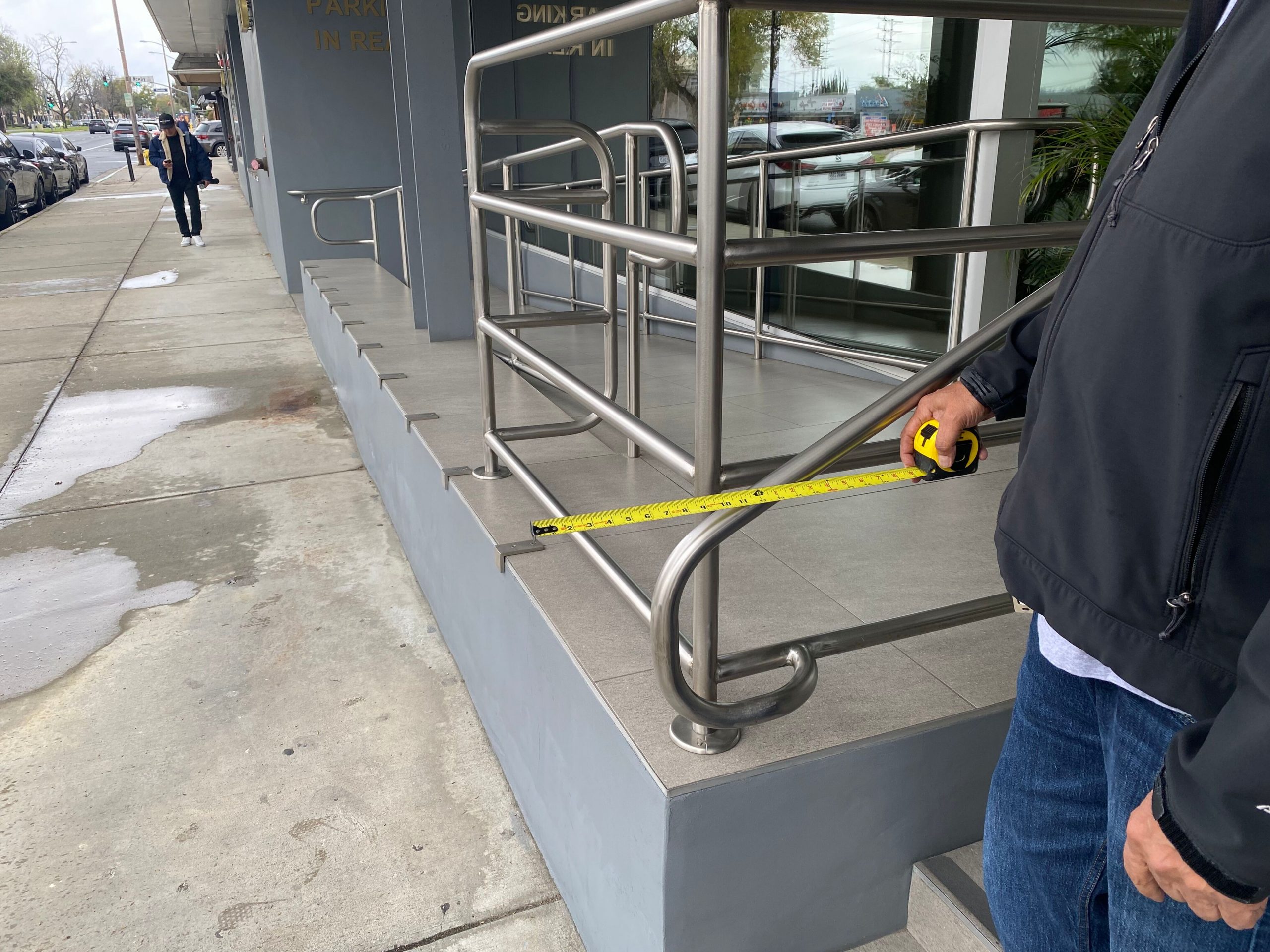
| Ramp width | 36″ [§405.5] | 48″ [11B-405.5] |
| Sidewalk / walk width | 36″ [§403.5.1] | 48″ [11B-403.5.1] |
| Toilet centerline from side wall | 16″–18″ [§604.2] | 17″–18″ [11B-604.2] |
| Door hardware height | 34″–48″ [§404.2.7] | 34″–44″ [11B-404.2.7] |
| Detectable warnings (truncated domes) | Visual contrast [§705.1.3] | Yellow, 70% contrast, 36″ deep at curb ramps [11B-705.1] |
| Restroom door symbols | Not required | 12″ circle (women), triangle (men), triangle-in-circle (all gender) [11B-703.7.2.6] |
A California business that is “ADA compliant” but not “11B compliant” can still be sued, because the Unruh Civil Rights Act treats a violation of either standard as a denial of equal access [Civ. Code §51(f), §55.52(a)(6)].
ADA compliant vs. accessible vs. code compliant
These three phrases are not interchangeable, and inspectors are careful about which one they write:
| Term | What it means | Who decides |
|---|---|---|
| ADA compliant | Meets the federal ADA Standards (and state code where stricter) | Ultimately a court; documented by a CASp inspection |
| Accessible | Usable by a person with a disability in practice; a broader, everyday word | The user |
| Code compliant | Passed the local building department’s inspection under the building code in force when the permit was issued | The building official |
The gap between the last two is where most lawsuits live. A building department signs off on a permit, not on the ADA, and never looks at a space again once the certificate of occupancy is issued. Sidewalks heave, striping fades, a tenant moves a counter, and the property stops being compliant without anyone noticing. The ADA has no grandfather clause, so “it passed inspection in 2009” is not a defense (see the ADA grandfather clause myth).
Who has to be ADA compliant?
Every place of public accommodation and every commercial facility, regardless of size [28 CFR §36.104]. Places of public accommodation fall into 12 categories: hotels and lodging; restaurants and bars; theaters and stadiums; auditoriums and convention centers; stores and shopping centers; service businesses such as banks, salons, dental offices, law offices and gas stations; transit stations; museums and libraries; parks and zoos; private schools; social service centers; and gyms and recreation facilities. Commercial facilities such as warehouses, factories and office buildings must comply when built or altered.
Three things owners often get wrong:
- There is no small-business exemption for buildings. The 15-employee threshold applies only to Title I (employment). A two-person nail salon is a place of public accommodation.
- Both landlord and tenant are responsible. The regulation names anyone who “owns, leases (or leases to), or operates” the place. A lease can allocate the cost between the parties, but it cannot remove either one from a lawsuit. See who is responsible for ADA compliance.
- Religious organizations and private clubs are exempt from Title III [42 U.S.C. §12187], but a church that rents its hall to the public, or runs a daycare, brings those spaces back in.
What ADA compliance looks like, element by element
A CASp inspection walks the property in the order a visitor experiences it, which is also the order the Department of Justice tells businesses to prioritize barrier removal [28 CFR §36.304(c)]. These are the measurements that come up on almost every report:
Parking and arrival
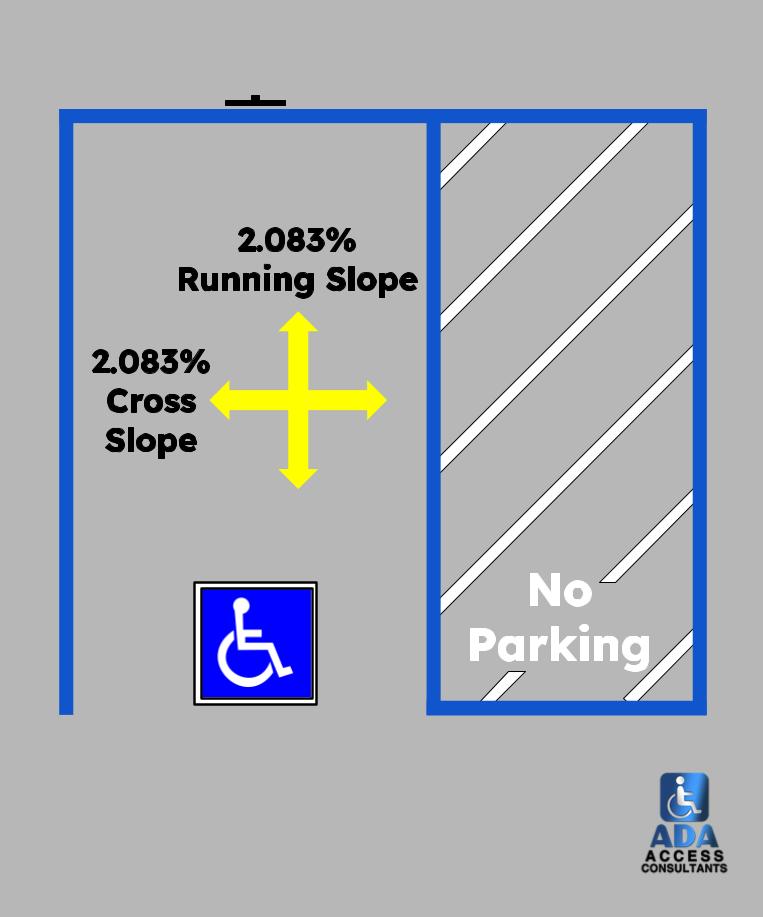
The right number of accessible spaces for the lot size (one for 1 to 25 spaces, two for 26 to 50, and so on up the table in §208.2), each with a striped access aisle at least 60 inches wide [§502.3], a surface slope no steeper than 1:48 in every direction [§502.4], and a sign with the International Symbol of Accessibility whose bottom edge is at least 60 inches above the ground [§502.6]. Parking is where drive-by lawsuits start, because every violation is visible from the street.
Accessible route and entrance
A continuous path at least 36 inches wide (48 inches for California sidewalks) from the parking, the public sidewalk and any transit stop to an accessible entrance, with a running slope no steeper than 1:20, a cross slope no steeper than 1:48, no steps, and no vertical change in level over ½ inch [§402–§403, §303]. The entrance door needs a 32-inch clear opening, lever or push-type hardware, no more than 5 pounds of opening force on interior doors, and level maneuvering clearance on both sides [§404].
Restrooms
A 60-inch turning space [§304.3], a toilet whose centerline is 16 to 18 inches from the side wall (17 to 18 in California) with a seat 17 to 19 inches high [§604.2, §604.4], a 42-inch side grab bar and a 36-inch rear grab bar mounted 33 to 36 inches above the floor [§604.5, §609.4], a sink with a rim no higher than 34 inches and knee clearance beneath it [§606], and dispensers, mirrors and hooks within the 15- to 48-inch reach range [§308]. Restrooms generate more violations per square foot than any other space; our 25 most common ADA bathroom violations lists them.

Counters, tables and seating
At least one section of every sales or service counter no higher than 36 inches and at least 36 inches long [§904.4]; dining and work surfaces 28 to 34 inches high with knee and toe clearance [§902]; 5 percent of tables (at least one) accessible [§226.1]; wheelchair spaces in any fixed seating [§221].
Signage
Permanent rooms identified with raised characters and Grade 2 Braille mounted 48 to 60 inches above the floor on the latch side of the door [§703], the International Symbol of Accessibility at accessible entrances and restrooms where not all are accessible [§216.6, §216.8], and in California the geometric door symbols on every restroom.
What “ADA compliant” means for a website
The ADA Standards above are about physical space. For websites, the Department of Justice takes the position that websites of public accommodations must be accessible under Title III, and in April 2024 it adopted WCAG 2.1 Level AA as the technical standard for state and local government websites under Title II [28 CFR §35.200]. For private businesses there is still no federal regulation that names a standard, but courts and settlements consistently use WCAG 2.1 AA, so “ADA compliant website” in practice means WCAG 2.1 AA. We cover this separately in our ADA compliant website guide; our inspections cover the building, not the site.
Is there an ADA compliance certificate?
There is no federal ADA certificate. The Department of Justice does not certify buildings, and any company offering an “official ADA certification” is selling its own paperwork. What does exist is the California Disability Access Inspection Certificate, a numbered, dated certificate a CASp issues after inspecting a site [Civ. Code §55.53(e)]. It can be posted at the entrance, and the status it records (“meets applicable standards” or “inspected by a CASp”) is what makes a California business a qualified defendant with reduced exposure in a lawsuit. Outside California, a CASp report serves as the written record that an owner acted in good faith and knows exactly what to fix.

How to find out if your property is ADA compliant
- Walk it yourself with a checklist. The free ADA small business resources and our list of common ADA violations will catch the obvious items: missing signs, faded striping, a trash can in the turning space.
- Measure the big six. Parking slope and stall width, route width and cross slope, door opening force, restroom turning space, grab bar placement, counter height. A $20 digital level and a $15 door-pressure gauge find most of what a plaintiff’s expert finds.
- Get a CASp inspection. A licensed inspector documents every element against both the ADA Standards and the state code, gives you a prioritized correction list with a schedule, and (in California) changes your legal status the day the report is issued. See what a CASp inspection costs.
What happens if you are not ADA compliant
Federally, a private plaintiff can sue under Title III for an injunction (an order to fix the barriers) and attorney’s fees, but not money damages [42 U.S.C. §12188]. The Department of Justice can seek civil penalties in its own cases. The real financial exposure is in state law:
- California: the Unruh Act adds statutory damages of at least $4,000 per occasion plus attorney’s fees [Civ. Code §52(a)]. A CASp-inspected business that corrects violations within 60 days of being served pays a minimum of $1,000 instead [Civ. Code §55.56(g)(1)], and a business with 50 or fewer employees owes no minimum statutory damages for 120 days after a CASp inspection if it fixes what the report found [Civ. Code §55.56(g)(3)].
- Other states: New York, Florida, Texas, Arizona and others see heavy Title III filing because federal attorney’s-fee awards make the cases worthwhile even without damages.
If you have already received a letter, start with our guide to what to do after receiving an ADA lawsuit.
Find out exactly where your property stands
A CASp inspection gives you a written, element-by-element answer and, in California, qualified-defendant protection. Call or text (949) 339-9429 for a free estimate. We inspect nationwide.
Frequently asked questions
What is the difference between ADA compliant and ADA accessible?
“ADA compliant” is a legal conclusion: the element meets the measurable requirements of the ADA Standards. “ADA accessible” is a description: a person with a disability can use it. A space can be accessible in practice and still non-compliant by an inch, and a lawsuit turns on the inch.
Does ADA compliance apply to my small business?
Yes. For buildings there is no size exemption. The only size-based relief is that barrier removal in an existing building must be “readily achievable,” which weighs the cost against your resources, and California’s reduced damages for small businesses that correct violations quickly.
Is my building ADA compliant if it passed the city inspection?
Not necessarily. The building department enforces the building code at permit time; it does not enforce the ADA, and it does not re-inspect. Elements built to code can also drift out of compliance through settlement, wear and tenant changes.
What does “ADA compliant” mean for a hotel room?
It means the room has the mobility features (roll-in shower or accessible tub, clear floor spaces, lowered controls) or communication features (visual alarms, notification devices) required by §224 and §806 of the Standards, in the quantities set by the hotel’s room count. See ADA hotel room requirements.
How often should a property be re-inspected?
After any alteration, after a change of tenant or use, and otherwise every few years, because exterior slopes and striping degrade. In California a posted certificate stays valid only until the site is modified in a way that affects compliance [Civ. Code §55.53(e)(3)].
Related definitions
ADA Title III · Place of public accommodation · Readily achievable · Safe harbor · CBC Chapter 11B · Certified Access Specialist · All ADA definitions
Sources: 2010 ADA Standards for Accessible Design (U.S. Access Board); 28 CFR Parts 35 and 36; 42 U.S.C. §§12181–12189; 2025 California Building Code Chapter 11B; California Civil Code §§51, 52, 55.52–55.56. Written for property owners and managers, not as legal advice.