ADA Reach Range Requirements Explained
What Are ADA Reach Ranges?
ADA reach range refers to the height range and location of elements or objects that people with disabilities need to use by means of reaching. This is especially important when providing access to your property. For example, having correct reach ranges can help a wheelchair user use an element such as a coat hook that isn’t installed too high. ADA reach range requirements in the ADA (Americans with Disabilities Act) require specific heights and locations to enable use for all people. These laws are set into place federally and apply to many types of businesses, residential facilities, websites, and more.
What Are ADA Reach Ranges?
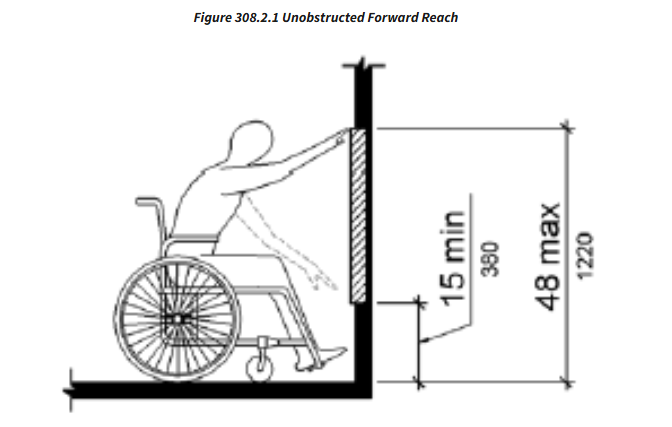
The ADA groups reach ranges into two categories, forward reach and side reach. Understanding both is fairly simple, however there are some slight differences.
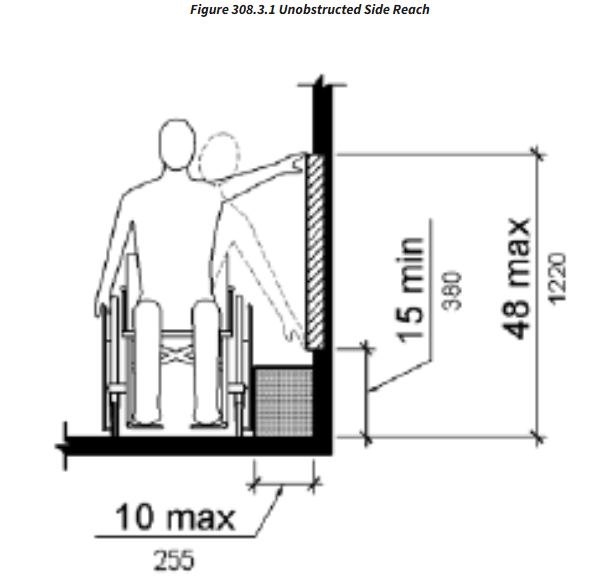
Unobstructed Side Reach Standards
For an unobstructed side reach, the height requirement is 15” minimum to 48” maximum. This is the standard reach range for most forward and side approaches. Once an obstruction is introduced, the range height changes.
Obstructed Side Reach Standards
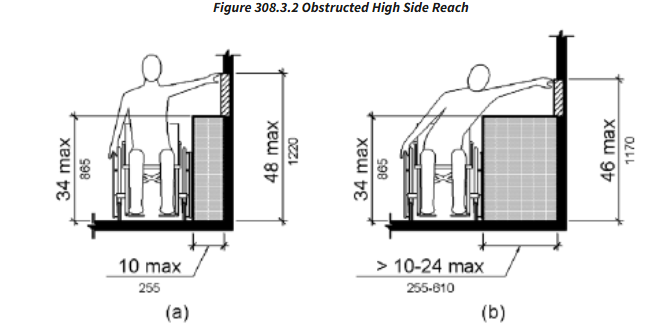
A side reach obstruction, in terms of the ADA, is a protrusion in front of an element spanning 11” to 24”. When an obstruction is present, ADA code requires a reduction of the maximum reach range height to 46”. This accounts for the distance the obstruction creates allowing a wheelchair user to still conveniently use the element.
ADA Reach Range Requirements for Children
When looking at reach ranges, a common overlooked but vital detail is the reach range height requirements for different ages. Children for example are much smaller than adults and require different reach ranges to account for their size. The ADA (Americans with Disabilities Act) outlines the differences in reach range requirements. The age ranges 3 through 4, 5 through 8, and 9 through 12 are listed below in the graph.
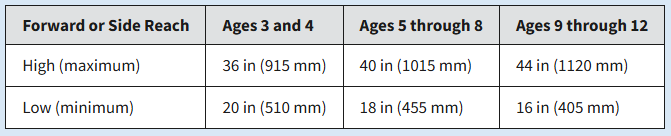
ADA Reach Range Requirements for Children
As ADA inspectors, the most common reach range violations we see are very minor and usually are a result of improper planning.
Controls Mounted Too High
The controls mounted too high is the most common violation we see. This usually happens because many installers mount elements at exactly 48” when they should be mounting them lower to account for any installation error or to account for protruding edges of the elment. Another thing to consider is the mounting hardware height is not what is measured, but the height of the operable part of the element.
Obstructions Limiting Accessibility
Another common mistake we see around ADA Compliant reach ranges are obstructions. Like mentioned previously, you are allowed to have obstructions in front of your elements however they cannot extend past 25” for side approaches and 10” for front approaches. Once they extend beyond those measurements, there is no room for a compliant reach range.
ADA Reach Range Compliance Tips
If you want to ensure your property meets ADA reach range compliance, we recommend hiring a professional inspection company like ADA Access Consultants. We’ll inspect your property and give you a detailed and comprehensive report that you can use to work towards ADA compliance. We have plenty of contractors to help you with the work and are happy to move quickly. Reach out for a free quote for an ADA reach range inspection today!